

Thick walls can turn an otherwise fast internet plan into a frustrating dead zone problem. The right mesh system helps move a stronger signal through brick, plaster, concrete, and older construction without constant buffering.
Below, we focus on the best mesh Wi-Fi systems for thick walls, with picks that balance range, stability, ease of setup, and real-world coverage for challenging homes.
Best 10 Mesh WiFi Systems for Thick Walls Picks for 2026
Top Pick for Thick Walls
TP-Link Deco XE75 AXE5400 Tri-Band WiFi 6E System

- Covers up to 7,200 sq. ft.
- 6 GHz band can act as backhaul
- Supports up to 200 devices
Best For: Large homes needing stable 6E mesh performance through thick walls
Best Budget Gigabit Mesh
Amazon eero 6+ Mesh WiFi System

- Supports internet speeds up to a gigabit
- TrueMesh reduces dead spots
- Built-in smart home hub included
Best For: Budget buyers who want dependable whole-home coverage
Best Renewed 6E Value
TP-Link Deco AXE5300 Wi-Fi 6E Mesh System

- Coverage up to 7,200 sq. ft.
- Tri-band mesh supports up to 200 devices
- Renewed option lowers the price
Best For: Value seekers who want renewed 6E coverage for large homes
Best Wired-Backhaul Pick
TP-Link Deco X55 AX3000 WiFi 6 Mesh System

- Coverage up to 6,500 sq. ft.
- Supports Ethernet backhaul
- Three Gigabit ports per unit
Best For: Thick-wall homes that can use wired backhaul
High-Capacity Wi‑Fi 6 Mesh for Thick Walls

- Up to 6,500 sq. ft. coverage
- 2 x 2.5G ports per unit for wired backhaul
- Supports 150+ devices with app setup
Best For: Large homes that need dependable WiFi 6 mesh and multi-gig ports
Tri-Band Mesh for Interference-Heavy Homes

- Tri-band WiFi 6E with a 6 GHz backhaul
- Up to 5,500 sq. ft. coverage
- Supports up to 200 devices with AI-driven mesh
Best For: Homes where thick walls and interference call for tri-band stability
Budget-Friendly Whole-Home Mesh

- Up to 5,500 sq. ft. coverage
- Single network name for roaming
- Supports wired Ethernet backhaul
Best For: Budget-conscious homes needing simple mesh coverage and wired-backhaul flexibility
Wi-Fi 6 Value Mesh
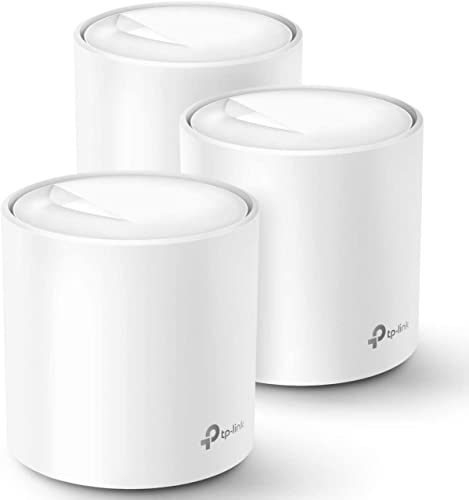
- Wi-Fi 6 mesh with up to 5,800 sq. ft.
- Supports up to 150 devices
- Works with wired backhaul
Best For: Large households wanting Wi-Fi 6 speed and solid mesh coverage
Premium Long-Range Tri-Band Mesh

- Wi-Fi 6E tri-band with up to 7,200 sq. ft.
- Dedicated 6 GHz backhaul for stability
- 2.5G port for multi-gig plans
Best For: Large homes and multi-gig users needing the strongest mesh option
Top Pick for Thick Walls – TP-Link Deco XE75 AXE5400 Tri-Band WiFi 6E System
If you need mesh WiFi systems for thick walls, the TP-Link Deco XE75 is built to reduce interference and keep nodes connected more reliably. Its 6 GHz band can serve as a backhaul by default, which helps maintain stable links between units while also freeing up the network for compatible devices.
Best For: Homes that need a strong, future-ready mesh system with tri-band performance and 6E support.
Pros:
- Wi-Fi 6E tri-band design covers up to 7,200 sq. ft.
- 6 GHz band helps reduce interference from legacy devices
- AI-driven mesh adapts to your network environment
- Supports up to 200 devices with combined speeds up to 5,400 Mbps
Cons:
- Wi-Fi 6E benefits are strongest with compatible devices
- A modem is required for most internet providers
For thick-wall homes, the XE75 stands out because its tri-band design and 6 GHz backhaul are aimed at keeping mesh connections stable where walls and interference usually cause trouble. It is a strong pick if you want wide coverage, modern Wi-Fi 6E features, and straightforward app-based setup.
Best Budget Gigabit Mesh – Amazon eero 6+ Mesh WiFi System
The Amazon eero 6+ is a practical choice in mesh WiFi systems for thick walls when you want reliable coverage without paying for premium 6E hardware. Its TrueMesh technology is designed to route traffic intelligently, helping reduce drop-offs and dead spots across the home.
Best For: Budget-conscious buyers who want dependable gigabit mesh coverage for everyday family use.
Pros:
- Supports internet plans up to a gigabit
- Covers up to 4,500 sq. ft. with a 3-pack
- TrueMesh helps reduce dead spots and drop-offs
- Built-in smart home hub supports Thread and Zigbee devices
Cons:
- Coverage is lower than some larger 3-pack systems
- Advanced security and management features may require a separate subscription
If your main goal is solid whole-home Wi-Fi rather than the latest wireless band, the eero 6+ keeps things simple and dependable. It is especially appealing for households that want easy setup, strong app management, and enough bandwidth for streaming, work, and video calls at the same time.
Best Renewed 6E Value – TP-Link Deco AXE5300 Wi-Fi 6E Mesh System
TP-Link Deco AXE5300 Wi-Fi 6E Tri-Band Whole-Home Mesh Wi-Fi System, 3-Pack (Renewed)
Check Price On AmazonFor mesh WiFi systems for thick walls, the renewed TP-Link Deco AXE5300 offers the same kind of wide-area 6E coverage you would expect from a premium mesh kit, but in a lower-cost renewed package. The tri-band layout and 6 GHz band are designed to support more devices while keeping coverage seamless across larger spaces.
Best For: Shoppers who want a renewed Wi-Fi 6E mesh system with strong coverage and tri-band backhaul.
Pros:
- Wi-Fi 6E tri-band system reaches up to 7,200 sq. ft.
- 6 GHz band supports the latest 6E devices
- Tri-band backhaul helps support up to 200 devices
- Works with all Wi-Fi-enabled devices and ISPs
Cons:
- Renewed unit comes with a shorter 90-day limited warranty
- Best 6E performance depends on compatible devices
This model makes sense if you want the coverage and interference-reducing benefits of 6E without paying full retail. It is a sensible fit for homes with tough wall layouts, especially when you want wide coverage and a tri-band mesh backbone.
Best Wired-Backhaul Pick – TP-Link Deco X55 AX3000 WiFi 6 Mesh System
If thick walls are the problem, the TP-Link Deco X55 is a smart mesh WiFi choice because it supports Ethernet backhaul for better speeds between units. That wired option can be especially helpful in homes where wireless signals have to travel through dense construction.
Best For: Homes that can use Ethernet backhaul to strengthen mesh performance through difficult wall layouts.
Pros:
- Covers up to 6,500 sq. ft. in a 3-pack
- Supports Ethernet backhaul for stronger inter-unit links
- Three Gigabit ports per unit add flexibility
- Can connect up to 150 devices
Cons:
- Dual-band design lacks the extra 6 GHz band of tri-band systems
- No modem built in
The X55 is a practical mesh option when you want broad coverage and the ability to hardwire nodes for a more stable setup. For thick-wall homes, that wired-backhaul support can be the difference between decent coverage and consistently strong performance.
Premium Wi‑Fi 7 Mesh for Large, Busy Homes – Orbi 360 WiFi 7 Mesh System
If you want mesh WiFi systems for thick walls, the NETGEAR Orbi 360 Series is built more for keeping performance steady across a large home than for acting as a modem replacement. Its WiFi 7 design, enhanced backhaul, and 6,000 sq. ft. coverage can help maintain stronger whole-home connectivity when you need reliable service for streaming, video calls, gaming, and multiple users.
Best For: Large households that want WiFi 7 mesh coverage, multi-gig wired ports, and built-in security features.
Pros:
- WiFi 7 mesh system with speeds up to 5 Gbps and backward compatibility.
- Enhanced backhaul and dual-band design aim to keep speeds more consistent across the home.
- 2.5G LAN ports on the router and each satellite support faster wired connections.
- Built-in security features, auto firmware updates, and NETGEAR Armor trial add extra protection.
Cons:
- Does not include a built-in modem, so you need a separate one.
- Only works in the U.S. according to the listing.
For thick-wall homes, this Orbi system is best when you want strong mesh performance plus multi-gig wired capability, not just basic signal extension. It is a premium pick for busy homes that need lots of device support and stable coverage.
High-Capacity Wi‑Fi 6 Mesh for Thick Walls – Deco X55 Pro Wi‑Fi 6 Mesh
For mesh WiFi systems for thick walls, the TP-Link Deco X55 Pro is a practical choice if you want broad coverage without jumping to the latest WiFi generation. It’s rated for up to 6,500 sq. ft. and can handle more than 150 devices, while the wired Ethernet backhaul and 2.5G ports give you flexibility for harder-to-reach rooms and faster internet plans.
Best For: Homeowners who want a reliable WiFi 6 mesh with strong coverage, multi-gig ports, and easy app setup.
Pros:
- Up to 6,500 sq. ft. of coverage for large homes.
- Each unit includes 2 x 2.5G ports for multi-gig internet and wired backhaul.
- Supports more than 150 devices, making it suitable for busy households.
- Free Deco app setup plus security, parental controls, and QoS features.
Cons:
- WiFi 6, not WiFi 6E or WiFi 7.
- Modem is not included.
This is a solid middle-ground option if thick walls make coverage uneven and you want strong value with advanced wired support. It focuses on dependable whole-home coverage rather than cutting-edge wireless speed.
Tri-Band Mesh for Interference-Heavy Homes – Deco XE75 Pro Wi‑Fi 6E Mesh
If thick walls and crowded wireless signals are your main problem, the TP-Link Deco XE75 Pro is a strong mesh WiFi system for thick walls because its 6 GHz band can be used as a stable backhaul by default. It covers up to 5,500 sq. ft., supports up to 200 devices, and offers a tri-band design that helps keep connections more consistent in challenging homes.
Best For: Homes needing tri-band WiFi 6E, strong backhaul stability, and coverage for lots of devices.
Pros:
- Tri-band WiFi 6E with a dedicated 6 GHz band for reduced interference.
- 6 GHz band can serve as backhaul by default for steadier node-to-node links.
- 2.5G port support helps take advantage of multi-gig broadband.
- AI-driven mesh, app setup, and HomeShield add convenience and security tools.
Cons:
- 2-pack covers less area than some larger 3-pack systems.
- Modem is required for most internet providers.
This model stands out when walls and wireless congestion are the issue, since the 6 GHz band helps the mesh stay organized behind the scenes. It is a smart pick for buyers who want better consistency more than raw headline speed.
Budget-Friendly Whole-Home Mesh – TP-Link Deco M5 3-Pack
For mesh WiFi systems for thick walls, the TP-Link Deco M5 is a practical pick if you want broad whole-home coverage without complicating setup. This 3-pack is designed to replace a router and extender combo with one seamless network, plus it supports wired Ethernet backhaul if you want to hardwire nodes for stronger performance in challenging layouts.
Best For: Homes that need simple, reliable coverage across multiple rooms and the option to use wired backhaul.
Pros:
- Covers up to 5,500 sq. ft. with three units
- Single network name for smoother roaming
- Supports wired Ethernet backhaul
- Includes HomeCare security, parental controls, and QoS
Cons:
- Dual-band design is less advanced than newer Wi-Fi 6 or 6E systems
- Coverage claims may still depend on layout and wall materials
The Deco M5 stands out as a straightforward mesh system for households that value simplicity, security tools, and flexible placement. If thick walls are part of the challenge, the ability to add wired backhaul can help make the system more dependable.
Wi-Fi 6 Value Mesh – TP-Link Deco X20 3-Pack
If you’re shopping for mesh WiFi systems for thick walls, the TP-Link Deco X20 brings Wi-Fi 6 performance and a 3-pack layout built for whole-home coverage. It is designed to reduce dead zones, handle more connected devices, and keep setup simple through the Deco app.
Best For: Larger homes that need Wi-Fi 6, strong device capacity, and easy app-based management.
Pros:
- Wi-Fi 6 mesh system with up to 5,800 sq. ft. coverage
- Supports up to 150 devices
- Works with wired backhaul for better performance
- Includes basic parental controls and TP-Link HomeShield security features
Cons:
- Dual-band design may not match tri-band systems in dense environments
- Coverage can still be affected by thick walls and home layout
The Deco X20 is a strong middle-ground option for families who need better speed and capacity than older mesh kits. Its Wi-Fi 6 support and wired backhaul make it especially appealing when walls and distance would otherwise weaken coverage.
Premium Long-Range Tri-Band Mesh – TP-Link Deco XE75 Pro 3-Pack
For mesh WiFi systems for thick walls, the TP-Link Deco XE75 Pro is the most advanced option in this group, with Wi-Fi 6E tri-band coverage and a dedicated 6 GHz backhaul. That extra band helps keep traffic moving between nodes, while the 3-pack design extends coverage across large homes with fewer interruptions.
Best For: Big homes, multi-gig internet plans, and users who want the strongest mesh hardware here.
Pros:
- Wi-Fi 6E tri-band mesh with up to 7,200 sq. ft. coverage
- Dedicated 6 GHz band helps stabilize node-to-node connections
- 2.5G WAN/LAN port supports faster multi-gig internet
- Up to 200 devices and wired Ethernet ports on each unit
Cons:
- Renewed unit, not brand new
- More advanced than many homes may actually need
This model is built for households that want the most headroom for range, speed, and device load. If thick walls are causing weak signals, the dedicated 6 GHz backhaul and tri-band design give it a meaningful advantage over simpler mesh systems.
How We Picked the Best Mesh WiFi Systems for Thick Walls
For Mesh WiFi Systems for Thick Walls, the most important factors are not just headline speed. We prioritized stronger whole-home coverage, tri-band or Wi-Fi 6E options where useful, good node-to-node performance, multi-gig or gigabit-capable ports, and systems that are easy to place and manage in real homes.
We also looked for models that can handle many connected devices, since thick-wall homes often need extra nodes in more rooms to maintain reliable performance.
Quick Comparison
If you want the simplest route, dual-band systems are usually best for smaller homes with moderate wall interference, while tri-band and Wi-Fi 6E models tend to hold up better when signals must pass through denser materials. Wi-Fi 7 is the newest option here, but it matters most if you also have fast internet, newer devices, and a home that benefits from higher capacity.
Key Buying Factors for Mesh WiFi Systems for Thick Walls
Coverage Is Only Part of the Story
Manufacturers list square footage, but wall material and layout matter more. A system rated for a larger area is often the safer choice for homes with multiple thick interior barriers.
Backhaul Performance
Tri-band and Wi-Fi 6E systems can reserve more airtime for communication between nodes. That helps reduce slowdowns when the signal has to travel through difficult construction.
Placement Flexibility
Look for systems with enough nodes and Ethernet ports so you can place units strategically instead of relying on one central location. In thick-wall homes, the best placement is usually closer to open doorways or hallways, not hidden in a corner.
Speed, Capacity, and Ports
If you stream in 4K, game online, or use multiple work devices, choose a mesh set with strong capacity and at least one fast WAN/LAN port. Multi-gig support can also help you avoid bottlenecks on faster plans.
Who Should Buy Which Mesh WiFi Systems for Thick Walls?
Choose a Wi-Fi 6 mesh system if you want dependable coverage at a lower cost and your internet plan is modest. Pick Wi-Fi 6E if your home has especially tough walls and you want more room for stable node communication. Go with Wi-Fi 7 only if you want the newest platform, have a fast plan, and plan to keep the system for years.
For larger homes with stubborn dead zones, the safest choice is usually one of the better tri-band Mesh WiFi Systems for Thick Walls, especially if you can use three nodes and place them thoughtfully. Smaller homes may be fine with a simpler two- or three-pack, but the layout should guide the final decision more than the spec sheet alone.
