

If you want safer backups, private cloud access, and smoother media sharing, a home NAS can be a smart upgrade.
These network attached storage devices for home use balance ease of setup, performance, and storage flexibility so you can choose the right fit quickly.
Best 10 Network Attached Storage Devices for Home Use Picks for 2026
Creator Hub NAS

- Intel N100 CPU with 8GB DDR5 RAM
- 2.5GbE plus dual M.2 NVMe slots
- Up to 80TB capacity with broad app support
Best For: Content creators and enthusiasts who want a fast home NAS
Private Cloud Pick
- Secure private cloud with multi-platform access
- Automated backups for Macs, PCs, and mobile devices
- Supports home security monitoring with IP cameras
Best For: Families wanting simple backups, sharing, and light surveillance
Budget Home Cloud
- 4TB HDD included for out-of-box use
- Subscription-free personal cloud access
- Includes backup tools and US-based support
Best For: Buyers who want a simple NAS with included storage
Backup & Security Hub

- Automatic backup for phones and computers
- Private file cloud with no subscription fees
- AI-powered home surveillance support
Best For: Individuals wanting a compact backup hub with security features
Beginner-Friendly Personal NAS
UGREEN DH2300 2-Bay Home Storage

- Designed for beginners leaving cloud storage behind
- Up to 64TB capacity with automatic backups
- AI photo tagging and duplicate detection
Best For: Beginners wanting simple private home storage for photos, backups, and media
Subscription-Free Shared Backup NAS
BUFFALO LinkStation SoHo 220 with Drives

- 12TB total capacity with drives included
- RAID 1 default for automatic backup protection
- Windows and macOS support with 24/7 US-based help
Best For: Households wanting a ready-to-use NAS with included drives and simple secure backups
Quiet 2.5GbE Media NAS
TERRAMASTER F2-425 Quiet 2-Bay NAS
- Intel x86 quad-core CPU with 4GB RAM
- 2.5GbE port for faster transfers and multi-user access
- Quiet 19dB(A) operation with easy tool-free drive install
Best For: Home media users who want fast streaming, quiet operation, and simple setup
Entry-Level Personal Storage
UGREEN DH2300 2-Bay NAS for Beginners

- 2-bay desktop NAS with up to 64TB support
- Cross-platform automatic backups for home devices
- AI photo tagging and duplicate-finding tools
Best For: Beginners who want simple private home storage and backup
Best Heavy-Duty Pick
Asustor Drivestor 4 Gen 2 4-Bay NAS

- 4 bays with RAID options for flexible home storage
- 2.5GbE port for faster transfers and streaming
- Btrfs snapshots and WORM for added data protection
Best For: Families who want a budget-friendly 4-bay home NAS
High-Capacity Custom NAS

- Up to 136TB with 4 bays and 2 M.2 slots
- Dual 2.5G + 1G LAN for fast, reliable transfers
- Supports Windows 11 Pro, TrueNAS, and Unraid
Best For: Power users wanting a large, customizable home NAS platform
Creator Hub NAS – UGREEN DXP2800 2-Bay
For buyers comparing network attached storage devices for home use, the UGREEN DXP2800 stands out as a more advanced two-bay option that still feels approachable. It combines an Intel N100 quad-core CPU, 8GB of DDR5 RAM, 2.5GbE networking, and dual M.2 NVMe slots, giving home users a strong mix of speed, flexibility, and room to grow.
Best For: Content creators, enthusiasts, and home users who want a fast, feature-rich NAS with room for large media libraries.
Pros:
- Intel N100 quad-core CPU and 8GB DDR5 RAM for responsive everyday performance
- 2.5GbE plus dual M.2 NVMe slots for a more capable home storage setup
- Supports up to 80TB, making it practical for photos, videos, and backups
- User-friendly app support across Windows, macOS, Android, iOS, web browsers, and smart TVs
Cons:
- Diskless design means you must buy drives separately
- More advanced specs may be more than basic backup-only users need
- Best value depends on how much you will use the extra speed and expansion features
This is a strong pick if you want a home NAS that can handle storage, sharing, and media use without feeling limited too quickly. Its AI photo features and broad app compatibility make it especially appealing for organizing a growing family or creator library.
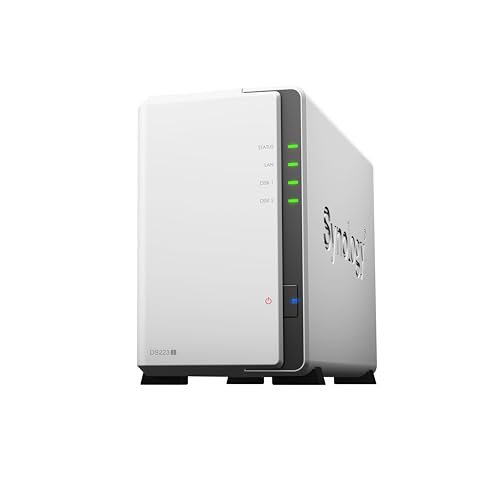
Private Cloud Pick – Synology DS223j
The Synology DS223j is a straightforward choice for network attached storage devices for home use when you want private cloud features without unnecessary complexity. It focuses on secure file access, simple sharing, automatic backups, and basic home surveillance support, making it a practical everyday NAS for households.
Best For: Families and home users who want an easy private cloud for backups, sharing, and light surveillance.
Pros:
- Secure private cloud with 100% data ownership and multi-platform access
- Automated backups for Macs, PCs, and mobile devices to multiple destinations
- Supports file sharing and syncing for home use and collaboration
- Can also support home security monitoring with multiple IP cameras
Cons:
- Diskless 2-bay design requires separate hard drives
- More entry-level than performance-focused NAS models
- Plastic enclosure and simple positioning suggest a budget-oriented build
If you mainly want a dependable home storage hub for backups, sharing, and private cloud access, the DS223j keeps the feature set focused and useful. It is less about high-end expansion and more about making core NAS tasks easy to live with.
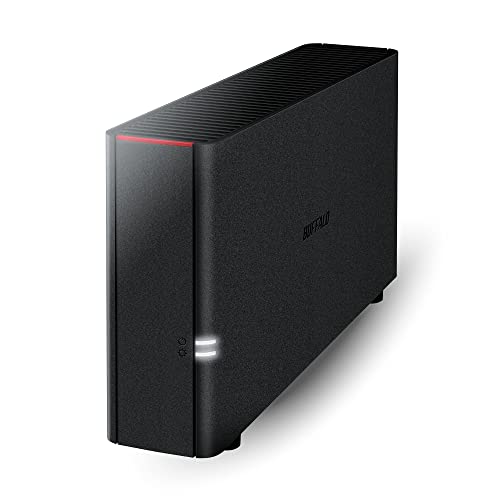
Budget Home Cloud – BUFFALO LinkStation 210 4TB
The BUFFALO LinkStation 210 is aimed at buyers who want network attached storage devices for home use with a simple setup and included storage. As a 1-bay NAS with a 4TB drive already installed, it is a convenient way to centralize backups, file sharing, and personal cloud access without adding separate drive purchases.
Best For: Home users who want an affordable, ready-to-use NAS with built-in storage.
Pros:
- 4TB HDD included, so it is ready to use out of the box
- Subscription-free personal cloud access for photos, music, and videos
- Closed system design and SSL encryption support data security
- Includes backup tools and 24/7 US-based support
Cons:
- Single-bay design offers less flexibility than multi-bay NAS units
- Built-in drive means fewer expansion options than diskless models
- Compatibility note limits macOS support to earlier versions for certain utilities
This model makes sense when convenience matters more than future expansion. It is a practical starter NAS for families who want a simple network storage device with included capacity and no monthly cloud fee.
Backup & Security Hub – Synology DS124
The Synology DS124 is a compact option for network attached storage devices for home use when your priorities are backup, file access, and light surveillance. This 1-bay diskless NAS is designed as a personal hub for photos, documents, and videos, with remote file access and AI-powered home monitoring features.
Best For: Individuals or small households that want a compact backup and file hub with home security features.
Pros:
- Automatically backs up photos, documents, and videos from phones and computers
- Private file cloud access with no monthly subscription fees
- AI-powered surveillance support detects people and vehicles with instant alerts
- Compact surface-mount design with a 2-year warranty
Cons:
- 1-bay diskless design requires you to supply your own drive
- Single-bay capacity is less flexible for growth and redundancy
- Focused feature set is better for personal use than heavy multi-user workloads
For a home user who wants a small, secure storage hub rather than a bigger multi-bay system, the DS124 keeps the essentials front and center. It is best viewed as a dependable private data center for backups and everyday access.
Beginner-Friendly Personal NAS – UGREEN DH2300 2-Bay Home Storage
If you’re comparing network attached storage devices for home use, the UGREEN NAS DH2300 is built for first-time buyers who want simple private storage without cloud subscriptions. This 2-bay, diskless NAS is aimed at personal backups, photo storage, and home entertainment, with easy remote access and cross-platform support for Windows, macOS, iOS, and Android.
Best For: Beginners who want an easy, private, entry-level home NAS for photos, backups, and media.
Pros:
- Entry-level system designed to be intuitive for users moving away from cloud storage or external drives
- Supports up to 64TB and automatic backups across devices
- AI photo features can tag faces, locations, texts, and objects, plus find duplicates
- Includes 1GbE, 4GB RAM, and 4K HDMI for basic home media use
Cons:
- Does not support Docker or virtual machines
- Wireless networking is not built in; Wi-Fi requires an external USB adapter
- Performance is positioned as limited for demanding users or advanced workloads
Overall, the DH2300 makes sense if you want a straightforward way to centralize family files and photos without overpaying for features you may never use. Its strengths are simplicity, privacy, and a beginner-friendly feature set rather than heavy-duty expandability.
Subscription-Free Shared Backup NAS – BUFFALO LinkStation SoHo 220 with Drives
BUFFALO LinkStation SoHo 220 2-Bay Personal Cloud Office NAS 12TB (2x6TB) with Hard Drives Included
Check Price On AmazonFor shoppers looking at network attached storage devices for home use, the BUFFALO LinkStation SoHo 220 focuses on straightforward shared storage with drives included. It’s built for organizing, backing up, and sharing family files, and it also emphasizes a closed system, SSL encryption, and subscription-free personal cloud access.
Best For: Home users who want an easy setup NAS with drives included and a simple, secure backup workflow.
Pros:
- Ships with 12TB total capacity and 2x6TB drives included
- RAID 1 is enabled by default for automatic backup, with RAID 0 available for full capacity
- Compatible with Windows and macOS, with 24/7 US-based support
- Includes backup tools, direct copy via USB, and file sharing for family and friends
Cons:
- macOS support note is limited to macOS 15 and earlier
- Uses 1GbE-class connectivity rather than faster 2.5GbE found on newer models
- Closed system limits third-party app flexibility
This model is a practical pick if you want a complete package with less setup work because the drives are already installed. It suits households that value dependable backup, simple sharing, and support over advanced customization.
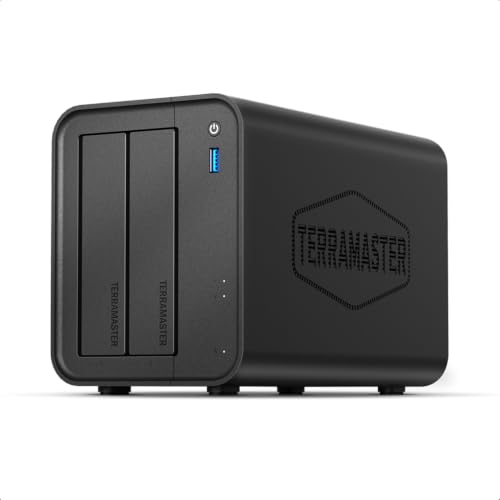
Quiet 2.5GbE Media NAS – TERRAMASTER F2-425 Quiet 2-Bay NAS
If you want network attached storage devices for home use with stronger performance, the TERRAMASTER F2-425 stands out as a compact multimedia server. It pairs an Intel x86 quad-core CPU with 4GB RAM and a 2.5GbE port, so it is aimed at faster transfers, 4K transcoding, and smooth streaming across multiple devices.
Best For: Home media users who want faster networking, quiet operation, and flexible streaming support.
Pros:
- Intel x86 quad-core processor with 4GB RAM for multitasking and 4K transcoding
- 2.5GbE LAN supports faster file transfers and concurrent access
- Works with Plex, Emby, Jellyfin, and DLNA for home streaming
- Very quiet at 19dB(A) with tool-free HDD installation
Cons:
- Diskless design means drives must be purchased separately
- Plastic enclosure may feel less premium than metal alternatives
- Geared more toward media and sync use than advanced server workloads
For a home setup centered on media playback, photo organization, and fast local transfers, this NAS offers a strong mix of speed and ease of use. It is a sensible choice if you want quieter hardware and better networking without stepping into a more complex server class.
Entry-Level Personal Storage – UGREEN DH2300 2-Bay NAS for Beginners
If you’re comparing network attached storage devices for home use, the UGREEN NAS DH2300 is aimed squarely at first-time buyers who want simple private storage for photos, videos, and personal files. It’s a 2-bay, diskless desktop NAS with cross-platform backup support, so it works as a straightforward step up from scattered cloud folders and external drives.
Best For: Beginners who want easy, private home storage for personal backups and media without advanced server features.
Pros:
- 2-bay design supports up to 64TB of total storage with drives added separately.
- Automatic backups work across Windows, iOS, Android, and macOS devices.
- AI-powered photo organization can tag faces, locations, text, and objects.
- One-time hardware purchase may be a simpler long-term alternative to recurring cloud fees.
Cons:
- Does not support Docker or virtual machines.
- Drives are not included, so you need to buy storage separately.
- Uses a 1GbE port, so it is not the fastest option in this group.
This model makes the most sense if you want a beginner-friendly NAS that keeps home media and backups organized without extra complexity. It focuses on ease of use and personal storage rather than advanced app hosting.
Best Heavy-Duty Pick – Asustor Drivestor 4 Gen 2 4-Bay NAS
For shoppers evaluating network attached storage devices for home use, the Asustor Drivestor 4 Gen 2 is a practical 4-bay option that balances capacity, speed, and backup features. Its 2.5GbE port, quad-core processor, and Btrfs snapshot support make it a strong fit for households that want a faster personal cloud and media server without moving into more complex hardware.
Best For: Families or home users who want a budget-friendly 4-bay NAS for backups, 4K streaming, and private cloud access.
Pros:
- 4-bay design supports RAID 0/1/5/6/10 for flexible storage and redundancy.
- 2.5GbE networking can improve transfer speeds over standard Gigabit NAS systems.
- Btrfs snapshots and WORM support add protection against accidental deletion and ransomware.
- Can serve as a home media server with 4K playback and streaming.
Cons:
- Only 1GB DDR4 RAM, which may limit heavier multitasking.
- Drives are not included, so total cost depends on the disks you choose.
- Best suited to home and small office tasks, not advanced server workloads.
Overall, this is a well-rounded home NAS if you want more expansion room than a 2-bay model and value secure backup features. It offers a sensible mix of speed, protection, and media support for everyday use.
High-Capacity Custom NAS – ACEMAGIC N3A 4-Bay Home Hub
If you need network attached storage devices for home use with more room to grow, the ACEMAGIC NAS N3A is built as a high-capacity desktop storage hub. It combines four HDD bays, two M.2 slots, dual 2.5G plus 1G LAN, and a pre-installed SSD, making it a flexible base for a private cloud, media server, or custom system.
Best For: Power users who want a large-capacity, customizable home NAS platform with fast networking and broad OS support.
Pros:
- Supports up to 136TB total storage with 4 HDD bays and 2 M.2 NVMe slots.
- Dual 2.5G + 1G LAN supports link aggregation and reliable network access.
- Includes 8GB DDR4 RAM and a pre-installed 128GB PCIe 3.0 SSD.
- Compatible with Windows 11 Pro, TrueNAS, Unraid, and other operating systems.
Cons:
- Diskless, so you still need to buy HDDs and/or SSDs separately.
- More advanced and flexible than a beginner-focused NAS, which may be overkill for simple backup needs.
- Home setup may take more effort because it is designed for customization.
This model stands out if you want a NAS that can scale far beyond basic family storage. It is especially appealing for buyers who value openness, upgrade options, and multi-role use from the same enclosure.
How We Picked the Best Network Attached Storage Devices for Home Use
We focused on Network Attached Storage Devices for Home Use that offer a practical mix of reliability, ease of management, and value. Priority went to models with solid app support, remote access options, sensible upgrade paths, and enough performance for backups, file sharing, and everyday streaming.
We also considered bay count, included drives versus diskless flexibility, network speed, and how well each unit fits beginners, families, content creators, and small-home office users.
Quick Comparison
In simple terms: 1-bay units are best for basic backup and low-cost storage, 2-bay models offer a stronger balance of redundancy and expansion, and 4-bay systems are better for users who expect growth, larger libraries, or multiple workloads.
Diskless models give you more control over drive choice, while bundled systems are convenient if you want a ready-to-use starting point. Faster Ethernet and NVMe support matter most if you move large files, edit media, or plan to serve several devices at once.
Key Buying Factors for Network Attached Storage Devices for Home Use
Bay Count and Redundancy
Choose the bay count based on how much data you have now and how much you expect to add. More bays generally mean more storage options and better resilience, especially if you want a redundancy setup like mirroring or parity.
CPU, RAM, and Network Speed
A faster processor and more memory help with photo indexing, app performance, backups, and multitasking. For home use, 1GbE is fine for basic file storage, but 2.5GbE is a worthwhile upgrade if you want better transfer speeds and smoother access across multiple devices.
Drive Type and Expansion
Check whether the NAS supports HDDs, SSDs, or both. If you need quieter operation, faster responsiveness, or room for future growth, expansion features such as M.2 slots or additional drive bays can matter a lot.
Software and Ease of Use
The best home NAS software should make backup schedules, mobile access, user permissions, and media libraries simple to manage. A clear interface is especially important if this is your first NAS.
Who Should Buy Which Network Attached Storage Devices for Home Use?
Buy a 1-bay model if you mainly need simple backup and don’t require drive redundancy. Choose a 2-bay NAS if you want the best all-around option for home storage, media, and safer data protection. Go with a 4-bay system if you expect your storage needs to grow, want more flexibility, or plan to run heavier workloads.
If you’re a beginner, prioritize an easier setup and strong app ecosystem. If you’re a creator or power user, look for faster networking, more RAM, and expansion features. If you just want affordable personal cloud storage, a bundled system with included drives may be the most convenient choice.
