

If your yard has slopes, dips, or rough patches, the right mower can save hours of work while delivering a cleaner cut. The best robotic lawn mowers for uneven terrain need more than simple automation: they need traction, reliable mapping, and obstacle awareness.
This roundup focuses on models built to handle challenging ground conditions without constant supervision. We prioritized slope performance, navigation quality, setup simplicity, and practical features that matter in real yards.
Best 10 Robotic Lawn Mowers for Uneven Terrain Picks for 2026
Compact Slope Helper

- Up to 35% slope climbing for small and medium lawns
- Optical navigation with ultrasonic obstacle avoidance
- Wire-free no-go zones using included magnetic strips
Best For: Smaller lawns with moderate slopes and simple setup
Smart Wire-Free Navigator

- RTK plus vision for centimeter-level mapping
- No wires, app-based multi-zone control, auto-resume
- Handles slopes up to 20° with 3D obstacle avoidance
Best For: Complex lawns needing precise mapping and app control
Heavy-Duty AWD Mower
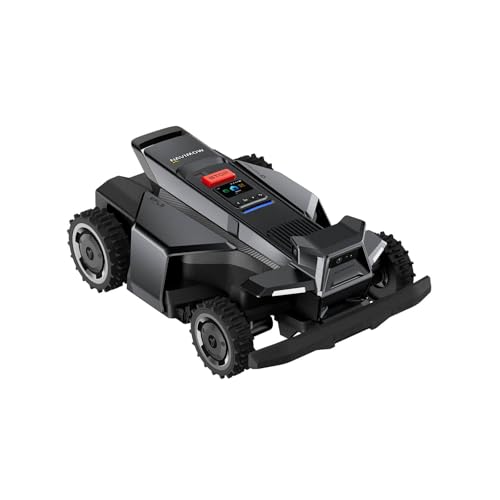
- 4WD with dual suspension for 84% slopes
- Zero-turn steering helps reduce turf scuffing
- RTK, 360° vision, and VIO for precise navigation
Best For: Large steep lawns needing top-tier traction and control
Wire-Free Precision Pick

- Wire-free dual-LiDAR mapping
- Built-in edge trimmer for borders
- Made for dense grass and uneven terrain
Best For: Medium yards with complex layouts and shaded areas
Compact Visual Navigator

- Camera-based obstacle detection
- Magnetic strip no-go zones
- Simple setup for small lawns
Best For: Small lawns that need easy setup and basic terrain handling
Steep-Slope Specialist

- Handles slopes up to 45%
- LiDAR and vision dual fusion navigation
- Off-road wheels with stability control
Best For: Steep, uneven lawns needing advanced slope performance
Wire-Free Vision Pick
YARDCARE M800Plus GPS Vision Mower

- GPS and 3D vision for cordless navigation
- Handles slopes up to 35% (20°)
- Includes magnetic strip for no-go zones
Best For: small yards with clear boundaries and moderate slopes
Steep-Slope Stability Choice
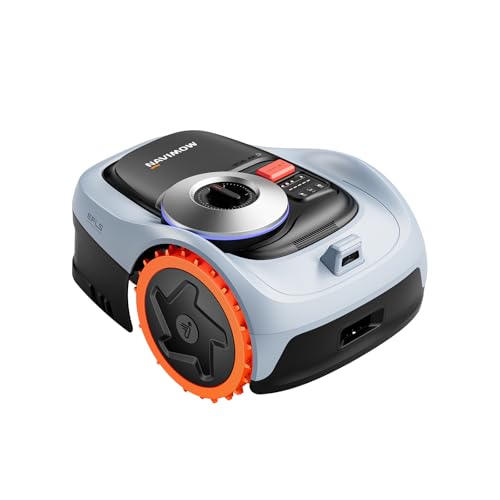
- All-wheel drive handles up to 45% slopes
- RTK + vision for centimeter-level accuracy
- Wire-free auto mapping with multi-zone control
Best For: small, steep, or uneven lawns needing maximum traction
Smart Mapping Option
WORX Landroid Vision Cloud WR310
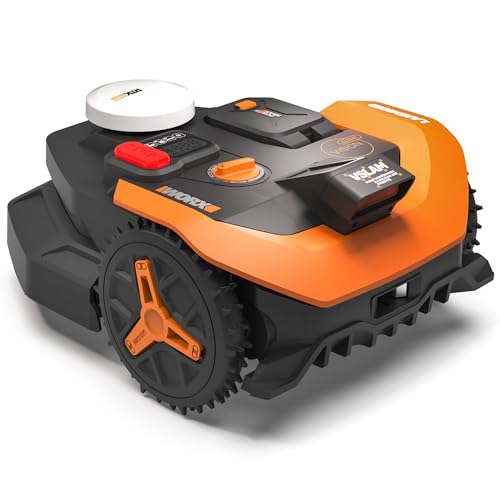
- RTK Cloud navigation without a local antenna
- Vision AI auto-maps complex yards
- Works in shade with V-SLAM sensor fusion
Best For: quarter-acre lawns with mixed light, shape, and border complexity
Premium All-Terrain AI Mower – AIRSEEKER TRON SE
If you’re comparing robotic lawn mowers for uneven terrain, the AIRSEEKER TRON SE stands out for steep slopes, off-road clearance, and AI-guided navigation. It combines mowing, mulching, and fertilizing in one system, while its dual hub motors and high-chassis design are built to keep moving across bumps, hills, and tricky lawn layouts.
Best For: Homeowners who want a wire-free mower for steep, uneven yards with smart obstacle detection.
Pros:
- Handles slopes up to 65% with dual hub motors and elevated chassis clearance.
- AI vision detects and avoids animals, furniture, tools, and other yard obstacles.
- Auto mapping creates virtual boundaries and no-go areas without manual setup.
- Swappable battery system supports longer mowing sessions with less downtime.
Cons:
- Higher-end feature set may be more than basic lawns need.
- Large system includes multiple setup components, including RTK hardware.
This is a strong option if your yard has slopes and rough patches that challenge standard robot mowers. Its focus on terrain handling and AI navigation makes it especially appealing for hands-free lawn care on complex properties.
Compact Slope Helper – LawnMaster OcuMow MAX
For shoppers looking at robotic lawn mowers for uneven terrain in a smaller yard, the LawnMaster OcuMow MAX offers a practical mix of optical navigation, obstacle avoidance, and slope handling. It is designed for small to medium lawns and uses a wire-free setup with magnetic strips, making it a simpler way to automate mowing without digging perimeter wire.
Best For: Small to medium lawns where slope handling and easy setup matter more than advanced mapping.
Pros:
- Covers up to 2,000-3,500 sq. ft. with up to 4 hours of runtime.
- Climbs slopes up to 35% using deep tread wheels and a robust drive system.
- Optical navigation and a wide-angle camera help guide mowing in tricky lighting.
- No-go areas are set with included magnetic strips, with no app required.
Cons:
- Best suited to clearly defined lawns with tidy edges.
- Smaller cutting width and mower size may mean slower coverage on larger properties.
This mower is a good fit if you want a straightforward, low-noise robot mower for a modest yard with some grade changes. It keeps setup simple while still adding the terrain help many compact lawns need.
Smart Wire-Free Navigator – YARDCARE N1600 PRO
If you want robotic lawn mowers for uneven terrain with precise navigation and zone control, the YARDCARE N1600 PRO is built around RTK plus vision guidance. It creates virtual boundaries in the app, maps multi-zone yards, and automatically returns to charge and resume, which makes it a useful choice for more complex lawns that need structured, hands-free mowing.
Best For: Medium-size properties that need accurate mapping, app control, and wire-free operation.
Pros:
- RTK and AI visual navigation deliver centimeter-level positioning.
- No boundary wires needed, with multi-zone control in the app.
- Auto-resume keeps mowing after charging without manual restart.
- 3D obstacle avoidance and strong traction support slopes up to 20°.
Cons:
- Slope handling is more moderate than the most rugged all-terrain models.
- Best suited to users comfortable managing zones through an app.
This model is a sensible middle ground if you want accurate, organized lawn care without perimeter wire installation. It may not be the steepest-climbing option here, but it brings reliable navigation and smart control to uneven yards.
Heavy-Duty AWD Mower – Segway Navimow X450
Among robotic lawn mowers for uneven terrain, the Segway Navimow X450 is the most aggressive all-wheel-drive option in this group. It is designed for large properties, steep slopes, and obstacle-crossing stability, using 4WD, dual suspension, and advanced positioning to keep mowing steady on complex ground.
Best For: Large, challenging lawns that need maximum traction, precise guidance, and advanced automation.
Pros:
- 4WD and ORV-tuned suspension handle 84% slopes and obstacles up to 2.8 inches.
- Zero-turn steering helps protect turf while improving maneuverability.
- Dual 180W motors, 17-inch cutting width, and fast mowing speed improve efficiency.
- RTK, 360° vision, and VIO support precise navigation under trees and in narrow spaces.
Cons:
- Large, heavy mower may be overkill for small yards.
- Advanced feature set likely places it at the premium end of the category.
This is the strongest all-terrain choice here if your lawn has steep grades and challenging transitions. It blends traction, speed, and high-end navigation in a package aimed at demanding, larger properties.
Wire-Free Precision Pick – ECOVACS GOAT A2000 LiDAR PRO
If you want robotic lawn mowers for uneven terrain without the hassle of perimeter wire setup, the ECOVACS GOAT A2000 LiDAR PRO is built around wire-free mapping and stable LiDAR positioning. Its dual-LiDAR system is designed to keep working in shaded spots, under trees, and near fences, while the built-in edge trimmer helps finish borders more cleanly than many standard robot mowers.
Best For: Medium-yard owners who want wire-free setup, precise navigation, and cleaner edge trimming on complex lawns.
Pros:
- Wire-free HoloScope 360° dual-LiDAR mapping with precise positioning, even in shaded areas
- Built-in TruEdge trimmer helps cut along driveways, sidewalks, flower beds, and irregular borders
- 32V platform and dual-blade disc are aimed at dense grass and uneven terrain
- Fast 50-minute recharge supports frequent scheduled mowing
Cons:
- Battery life is listed at about 50 minutes, so larger jobs may require multiple charging cycles
- Cutting width is relatively narrow at 3.6 inches
- Best suited to yards up to 1/2 acre rather than very large properties
Overall, this model stands out if your priority is dependable mapping without perimeter wires and cleaner border finishing. It looks especially practical for yards with tricky shapes, partial shade, or areas where GPS-based mowers can struggle.
Compact Visual Navigator – YARDCARE V100
For smaller properties looking at robotic lawn mowers for uneven terrain, the YARDCARE V100 focuses on camera-based navigation and simple setup. It uses visual sensing, bumper detection, and AI to identify obstacles, while the included magnetic strip makes it easy to create no-go zones without digging or boundary wire installation.
Best For: Small lawns that need a simple, low-noise robot mower with easy no-go zone control.
Pros:
- Camera-based navigation with bumper and visual sensors can detect many obstacle types
- Included magnetic strip makes it easy to set no-go zones around beds, pools, or paths
- No boundary wires required, which keeps setup straightforward
- Supports slopes up to 20 degrees and includes multiple safety features
Cons:
- Designed for small lawns up to 1,600 sq ft, so coverage is limited
- Cutting height range is narrower than some larger-capacity models
- Less terrain-focused than higher-end mowers built specifically for steep slopes
This is a practical entry-level pick for smaller yards where easy setup matters more than advanced terrain handling. Its strongest appeal is simplicity: a ready-to-use design, visual obstacle detection, and flexible no-go marking.
Steep-Slope Specialist – Segway Navimow i215 LiDAR
If your priority is robotic lawn mowers for uneven terrain with serious slope capability, the Segway Navimow i215 LiDAR is the strongest fit here. It combines LiDAR and vision navigation with off-road wheels, Electronic Stability Control, and support for slopes up to 45%, making it a standout choice for more demanding yards.
Best For: Homeowners with steep, uneven lawns who want strong slope handling and advanced mapping.
Pros:
- Supports slopes up to 45% with off-road wheels and Electronic Stability Control
- LiDAR and vision dual fusion offers satellite-free navigation day or night
- Auto mapping and app editing for up to 20 mowing zones add flexibility
- EdgeSense ride-on mode helps cut more cleanly along fences and pathways
Cons:
- Higher-tech feature set may be more than a simple small-yard user needs
- Cutting width is moderate at 7.1 inches, so larger lawns may take longer
- Best fit is for yards up to 0.37 acre, not bigger properties
Among the mowers in this roundup, this is the most obviously terrain-oriented option. It’s the one to look at when slope performance, stable navigation, and detailed app control matter more than basic plug-and-play convenience.
Wire-Free Vision Pick – YARDCARE M800Plus GPS Vision Mower
If you’re comparing robotic lawn mowers for uneven terrain, the YARDCARE M800Plus is aimed at smaller residential yards where you want wire-free setup, visual boundary detection, and reliable slope handling. Its GPS and 3D vision system is designed to identify grass and non-grass areas, while the included magnetic strip can help create no-go zones without digging or perimeter wire installation.
Best For: Homeowners with up to 8,611 sq. ft. who want a wire-free mower with vision guidance and moderate slope support.
Pros:
- GPS + 3D vision navigation supports cordless operation without traditional boundary wires.
- Handles slopes up to 35% (20°), which is useful on many uneven residential lawns.
- Included 32.8 ft magnetic strip helps define restricted areas without extra power or digging.
- App control lets you manage schedules, mowing patterns, and firmware updates remotely.
Cons:
- Best results depend on clear visual boundaries, so it may be less suited to ambiguous yard layouts.
- If grass exceeds 2.6 inches, initial manual trimming is recommended.
- 7-inch cutting width is relatively modest for larger mowing jobs.
Overall, the M800Plus is a practical pick if your yard has some slope and you want wire-free convenience with simple app-based control. Its strength is combining vision navigation with modest terrain capability rather than maximizing raw cutting speed.
Steep-Slope Stability Choice – Segway Navimow i206 AWD
For robotic lawn mowers for uneven terrain, the Segway Navimow i206 AWD stands out with all-wheel drive and automotive-grade stability control built for tougher slopes. It uses RTK plus vision for centimeter-level positioning, and the wire-free setup with one-tap auto mapping is aimed at homeowners who want a more advanced, hands-off system.
Best For: Small lawns with steep grades where stability, accurate navigation, and no-boundary-wire setup matter most.
Pros:
- All-wheel drive and electronic stability control are designed for up to 45% (24°) slopes.
- RTK + vision positioning offers centimeter-level accuracy for precise mowing paths.
- Wire-free auto mapping simplifies setup and removes the need for perimeter wires.
- Can manage up to 20 zones and sends GPS alerts if lifted or moved out of bounds.
Cons:
- Covers up to 0.15 acre, so it is best suited to smaller properties.
- Battery and runtime are geared more toward compact lawns than large-scale mowing.
- 7.1-inch cutting width is fairly narrow compared with larger mowers.
This is the strongest fit in the group if your yard has steep sections and you want a highly controlled, technologically advanced mower. It prioritizes traction and precision over broad coverage, which makes sense for challenging smaller lawns.
Smart Mapping Option – WORX Landroid Vision Cloud WR310
If you want robotic lawn mowers for uneven terrain plus easier setup on a larger suburban yard, the WORX Landroid Vision Cloud WR310 is built around camera-based AI and cloud RTK navigation. It can map complex lawn shapes, follow borders closely, and keep mowing even when parts of the yard are shaded or partially covered.
Best For: Homeowners with up to 1/4 acre who want AI obstacle handling, no perimeter wire, and strong edge coverage.
Pros:
- RTK Cloud navigation provides centimeter-level accuracy without a local antenna installation.
- Vision AI automatically maps lawn shapes and supports smoother edge-following.
- Handles shaded or partially covered areas by switching to V-SLAM sensor fusion.
- Supports unlimited zones, no-go areas, and app-based remote control.
Cons:
- 30% slope rating is solid, but less aggressive than the steepest terrain-focused models.
- Two-wheel drive may be less confidence-inspiring on very uneven ground than AWD alternatives.
- Best suited to 1/4 acre, so it is not intended for larger properties.
The WR310 is a balanced choice if your yard has mixed conditions and you care about smart mapping and cleaner borders more than brute-force traction. It offers advanced navigation features that help reduce missed grass and simplify ownership.
How We Picked the Best Robotic Lawn Mowers for Uneven Terrain
We focused on Robotic Lawn Mowers for Uneven Terrain that combine dependable traction, wire-free setup, and stable navigation on sloped or irregular lawns. We also looked for models with clear app controls, multi-zone support, and obstacle detection that helps reduce missed spots and collisions.
Because uneven yards can expose weak hardware fast, we gave extra weight to slope ratings, wheel or drive design, mapping accuracy, and cutting consistency around edges and terrain transitions.
Quick Comparison
For steep hills, prioritize all-wheel drive, high slope tolerance, and strong terrain handling. For mixed yards with obstacles and narrow passages, dual-sensor navigation or vision-based mapping is often the better fit. For simpler small lawns, compact wire-free models may be enough if the ground is only mildly uneven.
Key Buying Factors for Robotic Lawn Mowers for Uneven Terrain
Slope Handling and Traction
Check the maximum slope rating, but also look at drive type. AWD or larger, grippier wheels usually perform better on wet grass, loose soil, and side slopes. A mower rated for steep terrain is only useful if it can stay planted and maintain consistent cutting paths.
Navigation and Mapping
On uneven lawns, accurate mapping matters because bumps and grade changes can confuse weaker systems. RTK, LiDAR, and vision-based navigation can improve route planning, while multi-zone mapping helps larger or segmented yards stay organized.
Cutting Height and Deck Flexibility
An adjustable cutting height gives you more control when grass thickness changes across high and low spots. If your yard has rough ground, a mower that can adapt its deck or blade behavior may leave a more even finish.
Obstacle Detection and Edge Performance
Tree roots, garden borders, toys, and patio transitions are common in uneven yards. Good obstacle detection reduces bumps and detours, while edge-focused features help trim closer without frequent manual touch-ups.
Coverage and Setup
Match the mower’s coverage rating to your actual lawn size, then leave room for complex shapes and re-mowing on difficult terrain. Wire-free models are especially attractive if your layout changes often or if you want a faster installation.
Who Should Buy Which Robotic Lawn Mowers for Uneven Terrain?
If you have steep grades or the roughest terrain, choose a model with strong slope capability and AWD-style traction. If your lawn is medium-sized and full of obstacles, a LiDAR, RTK, or vision-guided mower will usually offer the best balance of precision and convenience. If you own a smaller yard with only light unevenness, a simpler wire-free model may be the most cost-effective choice.
In short, the best Robotic Lawn Mowers for Uneven Terrain are the ones that pair reliable navigation with real traction—not just smart app features. Focus on how the mower will behave on your worst patch of grass, not just the flattest part of the yard.
