

Choosing the right monitor for a three-phase electrical system is less about gadget appeal and more about getting reliable, actionable data. The best options track whole-home or circuit-level usage, work with your panel layout, and fit the way you actually manage energy.
In this roundup, we focus on smart home energy monitors for three-phase power that make it easier to spot waste, monitor solar export, and understand where electricity costs are really coming from.
Best 10 Smart Home Energy Monitors for Three-Phase Power Picks for 2026
Panel-Ready Commercial Pick
Emporia Vue 3 Commercial 3-Phase Smart Energy Monitor

- Supports 3-phase 4-wire wye with added 200A sensor
- Includes 16 circuit sensors for detailed monitoring
- Clamp-on install for non-invasive panel setup
Best For: Small businesses and homes needing circuit-level panel visibility
Flexible Higher-Voltage Monitor
Eyedro 3-Phase Commercial & Industrial Energy Meter
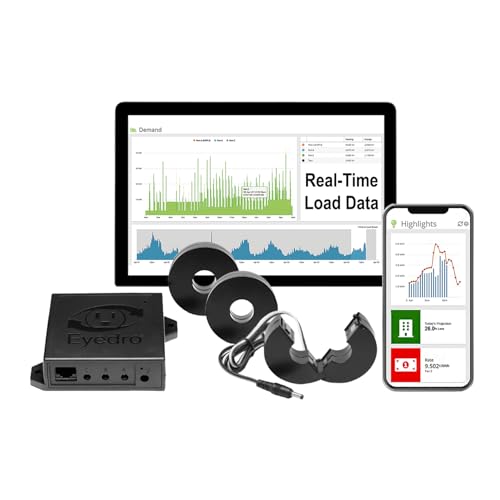
- Real-time kWh, watts, amps, volts, PF, and cost data
- WiFi or Ethernet connectivity with no subscription fee
- Supports multiple 3-phase voltage configurations
Best For: Commercial and industrial panels needing networked 3-phase data
Privacy-Focused Solar Monitor
Meross Smart Energy Consumption Monitor

- 18-circuit monitoring with 2 main circuits
- Home Assistant support for solar automation
- Local data with no subscriptions
Best For: Homeowners who want alerts, privacy, and solar control
High-Current 3-Phase Option
Eyedro 3-Phase Commercial & Industrial Energy Meter 400A

- Includes 3 x 400A steel CTs
- WiFi or Ethernet with real-time cost tracking
- Supports multiple 3-phase voltage types
Best For: Higher-current commercial panels needing 400A CTs
Rental Home Circuit Monitor

- 16 50A sensors for circuit-level tracking
- Supports three-phase up to 415Y/240VAC, no Delta
- Works with Home Assistant and LAN-only MQTT
Best For: Shared homes and rentals needing circuit-level billing on three-phase panels
Simple Three-Phase Clamp Meter

- Three 80A clamps for real-time load tracking
- Supports 3-wire and 3-phase Wye systems
- Bidirectional measurement for solar/net metering
Best For: Users wanting a simple WiFi clamp monitor for common three-phase panels
Privacy-First Energy Monitor

- Local Web UI, Open API, and MQTT with no cloud
- Native Home Assistant integration
- 2 main sensors plus 16 branch sensors
Best For: Home Assistant and solar users who want private local energy monitoring
Commercial 3-Phase Monitor
Emporia Vue 3 Commercial 3-Phase Smart Energy Monitor

- Supports 3-phase systems under 600A with included 200A clamps
- Tracks solar/net metering and real-time electricity usage
- Includes eight branch sensors for critical loads
Best For: Small businesses or homes using 3-phase power
UL-Certified Home Monitor
Emporia Vue 3 Home Energy Monitor
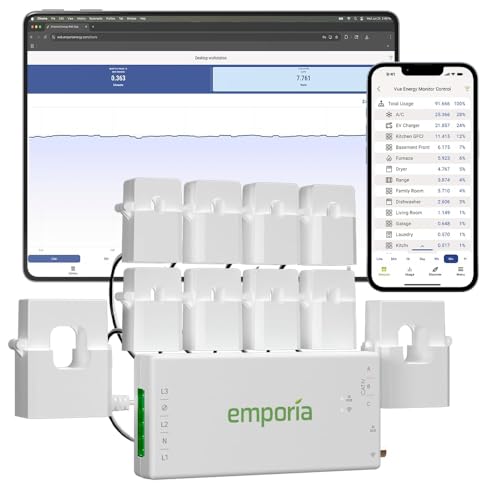
- UL and CE Listed for safety and reliability
- Works with 3-phase Wye systems using an extra sensor
- Tracks solar/net metering and real-time usage
Best For: Homeowners wanting certified whole-home monitoring
Expanded Circuit Monitoring
Emporia Vue 3 Home Energy Monitor with 16 Sensors
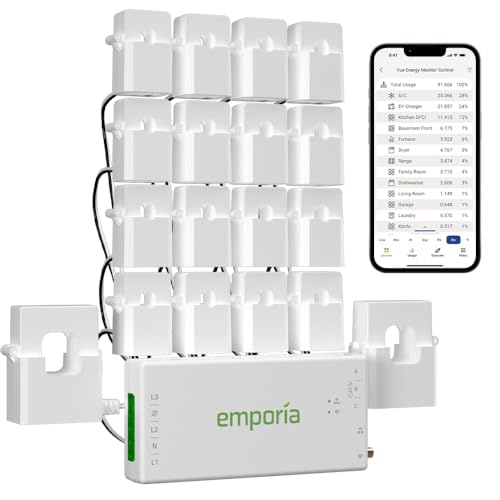
- Adds sixteen branch sensors for wider circuit coverage
- Supports 3-phase Wye systems with an extra sensor
- UL and CE Listed with solar/net metering tracking
Best For: Homes needing more circuit-level visibility
Panel-Ready Commercial Pick – Emporia Vue 3 Commercial 3-Phase Smart Energy Monitor
If you need smart home energy monitors for three-phase power that can also handle light commercial panels, the Emporia Vue 3 Commercial is built for that job. It uses clamp-on sensors for non-invasive monitoring, supports several common wiring setups, and adds 16 circuit sensors for more detailed whole-home or business visibility.
Best For: Small businesses and homes that want whole-panel monitoring with circuit-level detail.
Pros:
- Supports single-phase, single-split phase, 2-wire, 3-wire, and 3-phase 4-wire wye systems with an additional 200A sensor for supported setups.
- Includes 16 circuit sensors for detailed monitoring beyond just total usage.
- Clamp-on installation keeps setup non-invasive inside the circuit panel.
- Designed for solar and net metering use cases.
Cons:
- 3-phase 4-wire wye support requires an additional 200A sensor.
- May be more monitor than a simple whole-home buyer needs.
- Hardwired installation may be better suited to panel access than casual DIY use.
For buyers who want one monitor to cover multiple electrical layouts and circuit-level detail, this Emporia model is the most panel-focused option here. It stands out when you need broader compatibility plus more granular consumption insight.
Flexible Higher-Voltage Monitor – Eyedro 3-Phase Commercial & Industrial Energy Meter
For smart home energy monitors for three-phase power in higher-voltage commercial environments, this Eyedro meter is focused on real-time measurement and flexible connectivity. It reports kWh, watts, amps, volts, power factor, and cost, while supporting non-invasive clamp-on installation and 24/7 history through the MyEyedro platform.
Best For: Commercial and industrial users who want detailed 3-phase tracking with WiFi or Ethernet.
Pros:
- Real-time data includes kWh, watts, amps, volts, power factor, and cost.
- Works with WiFi or wired Ethernet for flexible networking.
- Supports multiple voltage options including 600V Delta, 480V/277V Wye, 208V/120V, and 3-phase high-leg delta.
- No subscription cloud software with full usage history, alerts, reports, and bill projections included.
Cons:
- Uses 3 x 200A sensors, so it is aimed at more substantial panel setups.
- Requires a free MyEyedro account to access the platform.
- Best suited to users comfortable configuring voltage, amperage, and rates in software.
This is a strong fit when your priority is flexible 3-phase monitoring with detailed electrical metrics and no ongoing software fee. It is especially appealing for sites that need Ethernet options or higher-voltage compatibility.
Privacy-Focused Solar Monitor – Meross Smart Energy Consumption Monitor
If you’re shopping for smart home energy monitors for three-phase power with a home-automation angle, the Meross EM16 is built around privacy, alerts, and circuit-level visibility. It supports common US home wiring types, includes 18 circuit monitoring points, and integrates with Home Assistant for local energy control and solar-aware automation.
Best For: Homeowners who want local monitoring, alerts, and Home Assistant integration.
Pros:
- Supports single-phase, single-split phase, and 3-phase 4-wire wye systems with earthed neutral.
- Tracks power, voltage, current, and power factor with up to ±2% accuracy.
- Offers 24/7 monitoring, smart alerts, and up to 5 years of data storage.
- Home Assistant support helps automate solar surplus usage for EV chargers and water heaters.
Cons:
- Not compatible with 3-phase delta systems based on the supplied notes.
- Requires a panel install with multiple sensors and wiring connections.
- Most automation value depends on using Home Assistant.
This model is especially attractive if you want local data, no subscription fees, and deeper home automation. It is a practical choice for solar households that want monitoring and control in one device.
High-Current 3-Phase Option – Eyedro 3-Phase Commercial & Industrial Energy Meter 400A
When you need smart home energy monitors for three-phase power with heavier CT capacity, this Eyedro version steps up to 3 x 400A sensors. It keeps the same real-time kWh, watts, amps, volts, power factor, and cost reporting, while remaining non-invasive and networked through WiFi or Ethernet.
Best For: Larger panels and higher-current 3-phase installations that need 400A sensors.
Pros:
- Includes 3 x 400A steel CTs for higher-current monitoring.
- Supports 600V Delta, 480V/277V Wye, 208V/120V, and 3-phase high-leg delta systems.
- Real-time monitoring covers energy use, solar generation, and cost data.
- No subscription cloud software with 24/7 history, alerts, reports, and bill projections included.
Cons:
- Designed for more demanding commercial and industrial installations.
- To break out grid consumption from solar generation, the notes indicate additional hardware is required.
- Requires setup through the MyEyedro platform and account creation.
If your panel calls for 400A sensors rather than the smaller included CTs in other models, this is the more capable Eyedro choice. It is best when you want high-current coverage without giving up detailed tracking or network access.
Rental Home Circuit Monitor – 16-Circuit, 3-Phase Ready
If you need smart home energy monitors for three-phase power in a rental or shared property, this SEM-Meter model stands out for its 16 branch sensors and phase-flexible monitoring. It supports single-phase, split-phase, and three-phase up to 415Y/240VAC (no Delta), making it a practical fit for panels that need circuit-by-circuit visibility and cost tracking.
Best For: Landlords, property managers, and shared homes that want detailed circuit-level billing and three-phase support.
Pros:
- Includes 16 50A circuit-level sensors for monitoring multiple appliances and rooms
- Supports three-phase up to 415Y/240VAC, plus single-phase and split-phase setups
- Offers real-time usage, app history, and electricity cost tracking
- Works with Home Assistant and can run in LAN-only MQTT mode for privacy
Cons:
- Does not support Delta three-phase systems
- Panels with busbar-only access may need flexible sensors sold separately
- Requires a compatible app or MQTT/Home Assistant setup for full use
This is a strong choice if you want detailed branch-level data instead of a single whole-home reading. Its billing and privacy features make it especially useful where usage needs to be split fairly across multiple occupants.
Simple Three-Phase Clamp Meter – 3 x 80A WiFi Clamp Monitor
For buyers comparing smart home energy monitors for three-phase power, this clamp-based Tuya-compatible unit is a straightforward option for real-time electricity tracking. It supports 3-wire and 3-phase, 4-wire Wye systems with neutral, and it uses three 80A CT clamps to monitor power, voltage, current, and power factor through the SmartLife app.
Best For: Homeowners who want a simple WiFi energy monitor for common three-phase and split-phase systems.
Pros:
- Three 80A clamp sensors support real-time monitoring of major appliances
- Compatible with single-phase, split-phase, and 3-wire / 3-phase Wye systems
- Tracks voltage, current, power, and power factor in the app
- Supports bidirectional measurement for solar/net metering setups
Cons:
- Requires 2.4 GHz WiFi with internet access for app monitoring
- Does not support Delta three-phase systems
- Fewer sensors and less circuit-level coverage than multi-branch monitors
This is a practical pick if you want basic three-phase visibility without a more complex installation. It covers the essential metrics and solar/net metering support, but it is best suited to users comfortable relying on cloud-connected app control.
Privacy-First Energy Monitor – Local Home Assistant Control
If privacy and automation matter most, this Refoss model is one of the more capable smart home energy monitors for three-phase power in a connected home. It offers local Web UI, Open API, and MQTT access without cloud dependence, plus native Home Assistant integration for users who want detailed energy data and automation on their own network.
Best For: Home Assistant users and solar homes that want local control, privacy, and automation.
Pros:
- Local Web UI, Open API, and MQTT work without relying on cloud services
- Native Home Assistant integration with no firmware flashing required
- Supports 2 main 200A sensors and 16 branch sensors for circuit-level monitoring
- Includes solar self-consumption automation and real-time alerts
Cons:
- Three-phase support is not explicitly detailed in the supplied notes
- More advanced local automation may be overkill for simple whole-home monitoring
- Initial setup will be more involved than a basic app-only clamp meter
This monitor is best when you want control, history, and automation without surrendering data to the cloud. For smart homes built around Home Assistant, it offers a strong mix of privacy, branch-level monitoring, and solar-focused scheduling.
Commercial 3-Phase Monitor – Emporia Vue 3 Commercial 3-Phase Smart Energy Monitor
If you need smart home energy monitors for three-phase power in a business panel or larger property, the Emporia Vue 3 Commercial is built around clamp-on monitoring, real-time usage tracking, and solar/net metering support. It’s designed for 3-phase systems under 600A with the included 200A clamps, and it can also handle several other electrical setups with the right sensor configuration.
Best For: Small businesses or homes with 3-phase, 4-wire Wye systems that want real-time monitoring and solar/net metering.
Pros:
- Supports 3-phase systems less than 600A with 3 included 200A clamps.
- Monitors solar and net metering for energy management and savings tracking.
- Includes eight 50A branch sensors for tracking critical loads.
- App-based alerts and automation help manage time-of-use and peak demand.
Cons:
- 3-phase, 4-wire Wye support requires an additional 200A sensor sold separately in some setups.
- Needs 2.4 GHz Wi-Fi and an internet connection for app access.
- 1-second data is only retained for 3 hours in the app.
This is the most specialized option in the lineup, and it makes sense if you need panel-level insight on a 3-phase system with branch circuit monitoring. For buyers who want business-style energy control and solar visibility, it offers the strongest fit.
UL-Certified Home Monitor – Emporia Vue 3 Home Energy Monitor
The Emporia Vue 3 Home Energy Monitor is a practical pick for smart home energy monitors for three-phase power when you want a UL-listed, app-based system with real-time usage tracking. It installs in the circuit panel with clamp-on sensors, supports several wiring types, and can work with 3-phase, 4-wire Wye systems when paired with an additional 200A sensor sold separately.
Best For: Homeowners who want UL-certified monitoring with solar/net metering support and basic branch-level insight.
Pros:
- UL Listed and CE Listed for safety.
- Supports 3-phase, 4-wire Wye systems with an additional 200A sensor sold separately.
- Monitors solar / net metering and real-time electricity usage.
- Includes eight 50A branch sensors for common household loads.
Cons:
- 3-phase support is not out of the box for every setup and may need extra sensor hardware.
- Requires 2.4 GHz Wi-Fi with an internet connection.
- 1-second data is only available while the app is actively open.
This model covers the essentials well: panel installation, app monitoring, and useful load tracking. If your priority is a safer, straightforward home energy monitor with three-phase compatibility, it’s an easy one to consider.
Expanded Circuit Monitoring – Emporia Vue 3 Home Energy Monitor with 16 Sensors
For buyers comparing smart home energy monitors for three-phase power, this Emporia Vue 3 version stands out because it adds sixteen branch sensors for more detailed circuit-level monitoring. It installs in the circuit panel, supports 3-phase, 4-wire Wye systems with an additional 200A sensor sold separately, and still keeps the core features of real-time usage tracking and solar/net metering.
Best For: Homes that want broader circuit monitoring and UL-listed monitoring with three-phase compatibility.
Pros:
- Includes sixteen 50A branch sensors for more circuit coverage.
- Supports 3-phase, 4-wire Wye systems with an additional 200A sensor sold separately.
- UL and CE Listed with a 1-year warranty.
- Tracks real-time energy data plus solar/net metering.
Cons:
- Three-phase support still depends on the correct sensor setup.
- Requires 2.4 GHz Wi-Fi and an internet connection.
- 1-second data retention is limited to 3 hours in the app.
This is the best choice in the group if you want more branch coverage without giving up the same core Emporia monitoring platform. It’s especially useful when you want a fuller picture of which circuits are driving energy use.
How We Picked These Smart Home Energy Monitors for Three-Phase Power
We prioritized monitors that can handle three-phase service accurately, offer useful real-time data, and provide a clear installation path for home or light commercial use. We also looked for support for solar/net metering, app or dashboard quality, and whether the product gives whole-panel visibility or deeper circuit-level insight.
Quick Comparison
For simple whole-home tracking, clamp-based monitors are often the easiest fit. For more detailed load breakdowns, circuit-sensor systems give better visibility but usually require more panel space and a more involved installation. If you want local control or custom integrations, look for models with API, web UI, or automation support.
Key Buying Factors for Smart Home Energy Monitors for Three-Phase Power
Phase Compatibility
Make sure the monitor explicitly supports three-phase service and matches your electrical setup, including voltage and current transformer requirements. Compatibility matters more than app features if the hardware cannot read your panel correctly.
Monitoring Depth
Decide whether you need whole-site consumption, per-circuit visibility, or both. Whole-home data is enough for bill tracking and trend analysis, while circuit-level monitoring helps identify which loads are driving demand.
Solar and Net Metering
If you have solar or plan to add it, choose a monitor that can track import and export cleanly. This is especially important for users who want to compare generation against usage in real time.
Connectivity and Data Access
Wi-Fi is convenient, but Ethernet can be more stable in utility rooms or commercial spaces. Advanced buyers may prefer platforms with local dashboards, open APIs, or no-cloud operation for better privacy and automation control.
Installation and Panel Fit
Three-phase systems often involve more complex panels than standard single-phase homes. Check sensor count, breaker space, clamp size, and whether professional installation is recommended before buying.
Who Should Buy Which Smart Home Energy Monitors for Three-Phase Power?
Homeowners who want easy energy awareness should lean toward straightforward whole-home monitors. Solar owners should prioritize models with strong net-metering support. Landlords, shops, and small businesses may benefit more from circuit-level or commercial-grade monitors that can separate loads and support more detailed reporting.
If your main goal is smarter energy management rather than just usage tracking, choose a monitor that fits your electrical setup first, then compare app quality, data access, and expansion options.
