

Smart weather stations with multiple sensors give you a clearer picture of local conditions than a single-point thermometer ever could. They track temperature, humidity, wind, rain, and more so you can make better decisions at home, in the garden, or on the jobsite.
In this roundup, we focus on the best options for 2026, from simple indoor-outdoor monitors to Wi-Fi-connected systems with app alerts, solar-powered sensor arrays, and advanced forecasting features.
Best 10 Smart Weather Stations with Multiple Sensors Picks for 2026
Long-Range LoRa Pick
4900FT WiFi Smart Weather Station

- LoRa range up to 4900 ft in open areas
- 7-in-1 outdoor sensor with app monitoring
- Supports multiple add-on sensors and CSV export
Best For: Large properties and users who need long-range wireless coverage
Trusted App-Ready Choice
- Measures wind, rain, UV, solar radiation, temp, and humidity
- Wi-Fi remote monitoring with alerts
- Smart-home support for IFTTT, Alexa, and Google Home
Best For: Homeowners who want dependable connected monitoring
AI Forecast Pick
Sainlogic SA9 Plus Smart WiFi Station

- Weatherseed AI forecasts with app and email alerts
- 7-in-1 sensor plus indoor thermo-hygrometer
- 8.5-inch display with 2-year exportable history
Best For: Users who want AI forecasting and easy data sharing
Premium Display Upgrade
- TFT color display with easy-to-view console
- All-in-one sensor array covers key weather metrics
- Wi-Fi connectivity with calibration support
Best For: Users who want a premium console and full outdoor sensing
Most Feature-Packed Multisensor Pick
3-Sensor Color Weather Station with Atomic Clock

- 3 wireless sensors track multiple locations
- 7.5-inch color touchscreen with forecast icons
- Includes atomic clock, dual alarms, and backlight
Best For: Households wanting a single display for several indoor/outdoor spots
Smart Home Climate Monitor
- 3 sensors cover multiple rooms or zones
- Gateway supports up to 1640 ft open-air range
- App, email, and buzzer alerts for threshold changes
Best For: Remote monitoring across rooms, basements, and greenhouses
Best Value Multi-Sensor Monitor
Color Weather Station with 3 Sensors

- 3 sensors with 500 ft wireless range
- 7.68-inch color LCD with forecast and trends
- USB or battery power for flexible placement
Best For: Straightforward monitoring for home, RV, garage, or garden
Family-Friendly Room Monitor
7.5-inch weather station with 3 sensors
- 7.5-inch HD display with clear layout
- Tracks up to 3 wireless sensors
- Atomic clock plus forecast and moon phase
Best For: easy-to-read home monitoring with basic multi-room coverage
App-Connected Data Tracker
WiFi weather station with 5 sensors

- Phone app with remote monitoring
- Supports up to 5 sensors
- Stores 1 year of data history
Best For: app-based monitoring and long-term temperature/humidity tracking
Long-Range Home Monitor
3-sensor weather station with atomic clock

- Shows 4 zones at once
- AA batteries last up to 12-24 months
- Atomic clock plus forecast and pressure
Best For: cordless multi-room monitoring with strong display readability
Long-Range LoRa Pick – 4900FT WiFi Smart Weather Station
If you want smart weather stations with multiple sensors for a large property, this LoRa-based model stands out for range and expandability. It combines a 7-in-1 outdoor sensor with Wi-Fi app access, CSV export, and calibration support, so it works well for monitoring both immediate backyard conditions and a few extra zones around the house.
Best For: Large yards, farms, greenhouses, detached buildings, and users who want long wireless range plus add-on sensor support.
Pros:
- LoRa transmission reaches up to 4900 ft in open areas for stronger sensor-to-console connection.
- 7-in-1 outdoor sensor tracks temperature, humidity, rain, wind speed/direction, UV, and light intensity.
- Supports multiple add-on sensors, including up to 7 temp/humidity sensors, 4 air quality sensors, and 3 water leak sensors.
- Includes a bonus indoor temp/humidity sensor for spots like basements, garages, or nurseries.
Cons:
- Uses multiple power options and requires 5 AA batteries, which are not included.
- Feature-rich setup may be more than casual users need.
This is a strong fit if range and future expansion matter more than keeping things simple. The large HD console, app access, and data export features make it a practical choice for serious home monitoring.
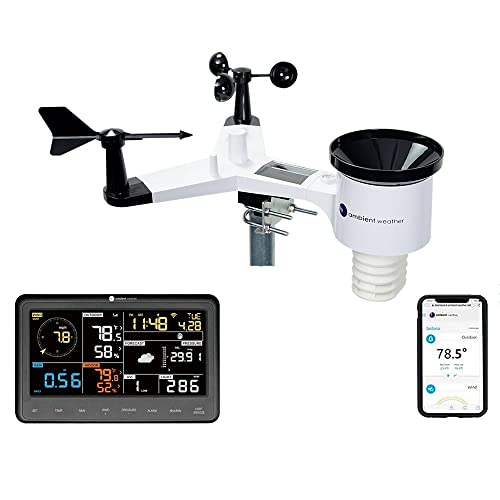
Trusted App-Ready Choice – Ambient Weather WS-2902
The Ambient Weather WS-2902 is a practical option in smart weather stations with multiple sensors if you want reliable home and backyard readings plus remote access. Its wireless sensor array captures wind, temperature, humidity, rainfall, UV, and solar radiation, while Wi-Fi and smart-home support add everyday convenience.
Best For: Homeowners who want a well-known Wi-Fi station with alerting, app access, and smart-home integration.
Pros:
- Measures wind speed/direction, temperature, humidity, rainfall, UV intensity, and solar radiation.
- Wi-Fi remote monitoring and alerts make it easy to check conditions away from home.
- Works with IFTTT, Google Home, and Alexa for smart-home routines.
- Ambient Weather Network access lets you share and customize weather data online.
Cons:
- Sensor array needs 3 AAA batteries, which are not included.
- No built-in multi-room add-on sensor expansion is listed in the supplied details.
This model keeps the feature set focused on core weather tracking and connected alerts. If you want a proven station with app support and a straightforward display, it remains an easy recommendation.
AI Forecast Pick – Sainlogic SA9 Plus Smart WiFi Station
For buyers comparing smart weather stations with multiple sensors, the Sainlogic SA9 Plus leans heavily into app features and forecasting. It pairs a 7-in-1 outdoor sensor with an indoor thermo-hygrometer, then adds Weatherseed AI forecasts, historical data export, and custom alerts for more proactive monitoring.
Best For: Users who want app-based forecasting, exportable history, and easy-to-read indoor/outdoor data.
Pros:
- Weatherseed AI app provides 24/7 forecasts plus app and email alerts.
- 7-in-1 outdoor sensor measures UV/sunlight, wind speed/direction, rainfall, temperature, humidity, and pressure.
- Large 8.5-inch screen with bold fonts and 3-level adjustable backlight improves readability.
- Supports historical data viewing and Excel export for up to 2 years.
Cons:
- Battery powered, so it may need more attention than a corded console setup.
- Some features depend on the Weatherseed app ecosystem.
This is a good fit if you value forecast tools and long-term data access as much as live sensor readings. The easy installation and clear display also make it approachable for first-time weather station buyers.
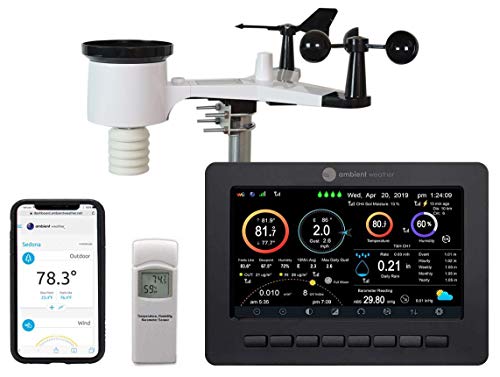
Premium Display Upgrade – Ambient Weather WS-2000
The Ambient Weather WS-2000 is a strong pick if you want smart weather stations with multiple sensors and a more premium-looking console. Its integrated all-in-one sensor array covers the main backyard weather metrics, while Wi-Fi connectivity and calibration support make it a practical step up for everyday monitoring.
Best For: Buyers who want a color TFT display and a full outdoor sensor array for home weather tracking.
Pros:
- Wireless all-in-one sensor array measures wind speed/direction, temperature, humidity, rainfall, UV, and solar radiation.
- TFT color display is designed for easy viewing.
- Supports imperial and metric units, with calibration available.
- Enhanced Wi-Fi connectivity can transmit data to the personal weather station network.
Cons:
- Sensor array requires 3 AAA batteries, which are not included.
- Some users may prefer a simpler setup since this model is feature-heavy.
If display quality matters and you want a capable all-in-one sensor package, this model is an appealing choice. It balances core weather tracking with network connectivity and flexible measurement options.
Most Feature-Packed Multisensor Pick – 3-Sensor Color Weather Station with Atomic Clock
If you want smart weather stations with multiple sensors for tracking different spots around the house, this LFF model covers a lot of ground. It comes with 3 wireless outdoor sensors, a large 7.5-inch color touchscreen, and handy extras like atomic time, dual alarms, and a 6-12 hour forecast based on barometric pressure changes.
Best For: Homes that need indoor/outdoor readings in several locations plus clock and forecast features in one display.
Pros:
- Includes 3 wireless sensors for monitoring up to three outdoor locations.
- Large 7.5-inch full-color touch display is easy to read at a glance.
- Built-in atomic clock, dual alarms, and 7 time zones add everyday utility.
- Forecast display, max/min records, and 3-level backlight improve day-to-day usability.
Cons:
- Sensors must be set to channels 1, 2, and 3 to connect properly.
- Battery mode turns the screen off after about 10 seconds to save power.
- Forecast is based on pressure trends, not live weather conditions.
This is a practical all-in-one option if you want a weather station that does more than basic temperature checks. The mix of three sensors, large display, and clock features makes it especially useful for busy households.
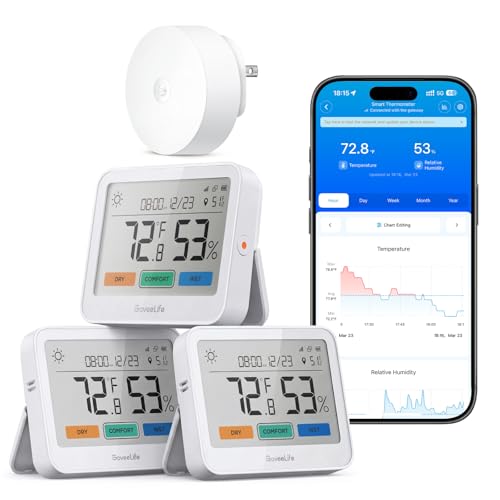
Smart Home Climate Monitor – WiFi 3-Pack with Gateway
For buyers comparing smart weather stations with multiple sensors, this GoveeLife 3-pack stands out for remote monitoring and app-based alerts. It combines temperature, humidity, comfort readings, and local weather forecasts with a gateway-powered range that can reach up to 1640 ft in open air.
Best For: Remote climate monitoring across multiple rooms or outbuildings with app alerts and a long wireless range.
Pros:
- 3-pack setup lets you monitor several spaces at once.
- Gateway support enables up to 1640 ft open-air range.
- Custom alerts can be sent by app, email, push, or gateway buzzer.
- High-precision sensor offers fast 2-second refresh and strong temp/RH accuracy.
Cons:
- Local weather forecast requires the gateway.
- Designed for indoor use rather than outdoor exposure.
- Uses AA batteries, so you’ll need to manage replacements over time.
This is the most connected option in the group, especially if you want one system to cover a house, basement, garage, or greenhouse. It leans more toward climate monitoring than a full weather-station dashboard, but the alerts and range are impressive.
Best Value Multi-Sensor Monitor – Color Weather Station with 3 Sensors
This OBET model is a strong fit if you want smart weather stations with multiple sensors and a larger display without overcomplicating setup. It pairs a 7.68-inch color LCD with 3 sensors, customizable alerts, barometric pressure trends, and a 12-hour forecast, plus USB or battery power options.
Best For: Users who want a straightforward multi-sensor station for home, garage, RV, or garden monitoring.
Pros:
- Includes 3 sensors with a 500 ft wireless range.
- Large 7.68-inch color screen shows temp, humidity, trends, and forecast info.
- Customizable alerts and max/min records add practical monitoring tools.
- USB or battery power gives flexibility in placement.
Cons:
- USB plug is not included.
- Humidity accuracy is listed at +/-5%, which is less precise than some alternatives.
- Best accuracy depends on careful sensor placement away from sun, rain, and ground.
Overall, this is a versatile pick for people who want multiple sensors, clear readings, and a simple forecast display. It is especially appealing if you need one station to cover several areas without jumping to a more expensive smart ecosystem.
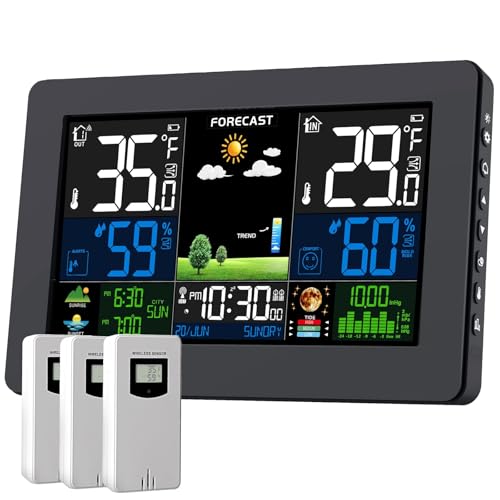
Family-Friendly Room Monitor – 7.5-inch weather station with 3 sensors
If you want smart weather stations with multiple sensors for easy whole-home monitoring, this model stands out for its big screen and three-sensor setup. It combines indoor-outdoor temperature and humidity tracking with barometric forecasting, moon phase data, and an atomic clock, making it a practical pick for everyday weather awareness.
Best For: Households that want a large, easy-to-read display and simple multi-room weather tracking.
Pros:
- Supports up to 3 wireless sensors for multi-point monitoring.
- Large 7.5-inch HD display with clear, high-contrast layout.
- Includes atomic clock, DST support, weather forecast, and moon phase.
- Can run on adapter power for always-on viewing, with batteries as backup.
Cons:
- Forecast accuracy depends on a 7- to 10-day barometric calibration period.
- Battery power mode does not keep the screen constantly lit.
- Sensor count is limited to three.
This is a straightforward choice if readability matters most and you want core weather data without extra app setup. The strong display and multi-sensor support make it useful for general home monitoring, but it is best suited to buyers who can wait for the forecast to settle in over time.
App-Connected Data Tracker – WiFi weather station with 5 sensors
For buyers comparing smart weather stations with multiple sensors, this WiFi model leans heavily into remote access and data history. It pairs up to five temperature and humidity sensors with a phone app, so you can check readings in real time and review stored data over the long term.
Best For: Users who want app-based monitoring, historical data, and coverage across several rooms or spaces.
Pros:
- Connects with a phone app for remote real-time monitoring.
- Supports up to 5 wireless sensors for broader coverage.
- Stores data for 1 year and lets you view historical trends.
- Compact rechargeable design with multiple mounting options.
Cons:
- WiFi support is limited to 2.4G networks only.
- Sensors require 2 AAA batteries, which are not included.
- If a sensor drops off, all sensors may need to be re-paired.
This is the most app-oriented option in the group, and its history logging makes it especially useful if you care about trend tracking, not just current readings. It is a strong fit for organized users who want flexible placement and several sensor zones.
Long-Range Home Monitor – 3-sensor weather station with atomic clock
If you need smart weather stations with multiple sensors for dependable room-to-room coverage, this Newentor model focuses on range, readability, and battery life. It shows temperature and humidity across four zones at once, adds barometric pressure and forecast data, and keeps time with an atomic clock.
Best For: People who want a battery-powered multi-zone station with strong visibility and long sensor range.
Pros:
- Displays readings for four locations at once.
- Runs on AA batteries for up to 12-24 months.
- High-contrast screen is designed for easy at-a-glance reading.
- Includes atomic clock, weather forecast, barometric pressure, and comfort indicators.
Cons:
- Does not include WiFi or app connectivity.
- Best performance depends on a stable RF sensor link.
- It is battery-powered, so there is no always-on backlight listed.
This is a practical pick if you prefer a cordless setup and want a station that can sit or mount almost anywhere. The combination of long battery life, strong visibility, and multi-sensor monitoring makes it a solid everyday home weather hub.
How We Picked These Smart Weather Stations with Multiple Sensors
We prioritized accuracy, sensor range, wireless reliability, ease of setup, display quality, app support, and overall value. We also looked for models that make sense for different users, whether you want a basic multi-room temperature monitor or a more advanced home weather hub with remote access.
Because Smart Weather Stations with Multiple Sensors can vary widely, we favored systems that balance useful data with practical everyday use. That means clear displays, dependable outdoor sensors, and features that are helpful rather than gimmicky.
Quick Comparison: What Matters Most
If you want the simplest option, choose a station with indoor and outdoor temperature plus humidity and a readable screen. If you need more insight, look for wind, rainfall, UV, and dew point readings. If remote monitoring matters, Wi-Fi and app alerts are the biggest upgrades.
For larger properties or more flexible placement, pay attention to signal range and sensor type. Systems with stronger wireless transmission or hub-based connectivity are usually easier to scale and more reliable across distance.
Key Buying Factors for Smart Weather Stations with Multiple Sensors
Sensor Coverage
More sensors are not always better unless they measure the data you actually need. Homeowners may only need indoor/outdoor temp and humidity, while gardeners and hobby meteorologists will benefit from wind speed, rain, and UV tracking.
Connectivity and Alerts
Wi-Fi models let you check conditions from your phone and can send alerts for thresholds like freezing temperatures or heavy rain. If you want convenience and peace of mind, this is one of the most useful features to look for.
Display and Readability
A strong backlit display is important if you plan to check the station often. Large icons, color coding, and clear trend indicators make it easier to understand changing weather at a glance.
Placement and Power
Outdoor sensors should be easy to mount and powered in a way that fits your setup. Solar assist can reduce maintenance, while long battery life is helpful when you need flexible placement away from outlets.
Who Should Buy Which Smart Weather Stations with Multiple Sensors?
If you want basic household monitoring, a straightforward indoor-outdoor station with a few sensors will likely be enough. If you want real-time weather access from anywhere, choose a Wi-Fi-enabled model with app support.
Gardeners, farmers, and weather enthusiasts should focus on more advanced Smart Weather Stations with Multiple Sensors that include rain, wind, and forecast features. For multi-room or multi-area monitoring, look for systems that support several remote sensors and offer easy expansion.
The best choice is the one that matches your space, your data needs, and how often you plan to check the weather. Prioritize dependable measurements first, then add smart features that make daily use easier.
