

Smart weather stations with solar sensors make it easier to track backyard conditions with less maintenance and better placement flexibility. They can help you monitor temperature, rain, wind, humidity, and more from indoors or on your phone.
Below, we highlight standout picks for different budgets, range needs, and smart-home preferences so you can choose the right station with confidence.
Best 10 Smart Weather Stations with Solar Sensors Picks for 2026
Dual-Band Connectivity Pick
Sainlogic 5G/2.4G WiFi Weather Station

- Dual-band 5G/2.4G WiFi for steadier app syncing
- 443 ft outdoor sensor range for flexible placement
- 2-year storage with CSV export for trend review
Best For: Buyers who want stable WiFi monitoring and detailed rainfall records
Hyper-Local Display Choice
Ambient Weather WS-2902 Wi-Fi Weather Station
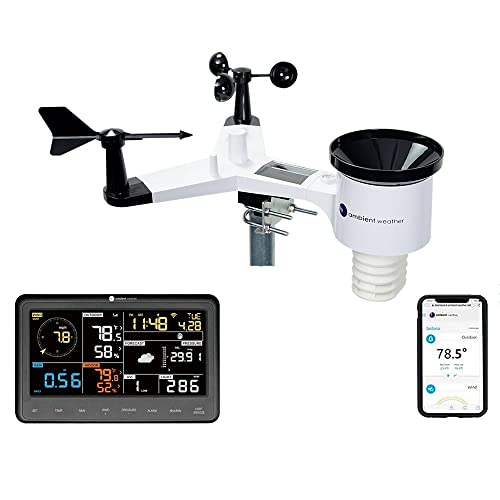
- Tracks wind, rain, UV, solar radiation, temp, and humidity
- Wi-Fi alerts and remote monitoring support smart-home use
- Color LCD display keeps backyard data easy to read
Best For: Homeowners who want a complete outdoor sensor suite with smart-home compatibility
AI Forecast Upgrade
Sainlogic SA9 Plus Smart WiFi Weather Station

- Weatherseed AI app offers 24/7 forecasts and alerts
- 7-in-1 outdoor sensor includes UV and sunlight readings
- 8.5-inch display is designed for easy readability
Best For: Users who want AI-powered forecasts and detailed app-based weather history
Premium Display Pick
Ambient Weather WS-2000 Smart Weather Station
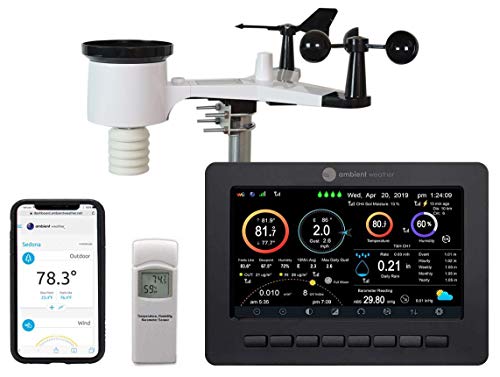
- Tracks wind, rain, UV, solar radiation, temp, and humidity
- TFT color console offers a cleaner premium display
- Wi-Fi sharing supports broader weather network use
Best For: Users who want a higher-end console with wireless outdoor monitoring
Hyperlocal Backyard Readings
AcuRite Iris 5-in-1 Weather Station
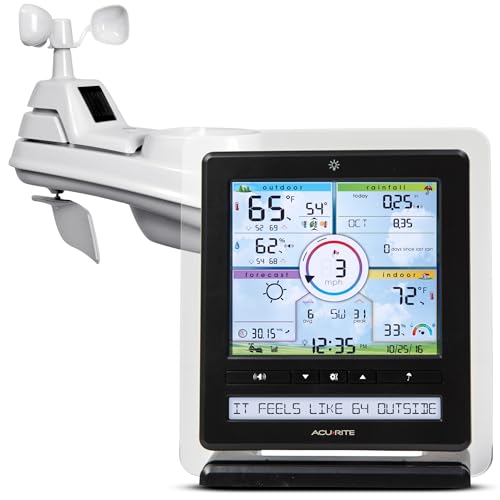
- Tracks wind, rain, pressure, and temperature
- Self-calibrating forecast personalizes local predictions
- Color LCD display includes ticker and dimmer
Best For: Home users who want a dependable, display-first weather station with detailed backyard readings
Smart Connected Monitoring
Ambient Weather WS-5000 Ultrasonic Station
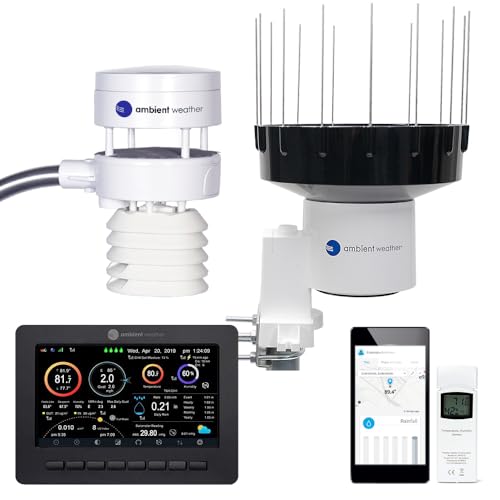
- Ultrasonic array updates readings every five seconds
- Wi-Fi and remote monitoring support smart-home use
- AWN+ adds graphing, alerts, and map layers
Best For: Buyers who want a connected, automation-friendly weather station with frequent updates
Advanced Wi-Fi Tracking

- Tracks 20+ data points including UV and light
- Direct Wi-Fi enables remote smartphone or desktop viewing
- Lightning detection adds storm awareness up to 25 miles
Best For: Users who want a highly detailed Wi-Fi weather station with storm monitoring
Long-Range Smart Weather Pick
4900FT LoRa WiFi Weather Station with Solar Sensor

- Up to 4900 ft LoRa range in open areas
- 7-in-1 solar outdoor sensor with bird spikes
- CSV export, app access, and add-on sensor support
Best For: Large properties that need long-range wireless weather monitoring
AI Forecast Value Pick
Sainlogic Smart WiFi Weather Station

- AI-driven forecasts and phone alerts
- 2-year data archive with Excel export
- High-contrast screen with large digits
Best For: Users who want connected forecasting and easy-to-read weather data
Dual-Band Connectivity Pick – Sainlogic 5G/2.4G WiFi Weather Station
If you want smart weather stations with solar sensors-style remote monitoring features, this Sainlogic model is built around dependable app access, long-range sensor placement, and detailed rain tracking. The dual-band 5G/2.4G WiFi setup is designed to reduce dropouts, while the outdoor sensor can be placed far from the console for broader yard coverage.
Best For: Buyers who want stable WiFi monitoring, long-range outdoor sensing, and detailed rainfall records.
Pros:
- Dual-band 5G/2.4G WiFi aims to improve connection stability and lower lag.
- 443 ft wireless range supports placement in remote yards, gardens, or detached structures.
- High-precision rainfall monitoring records hourly through yearly totals.
- 2-year data storage with CSV export is useful for trend tracking and review.
Cons:
- Solar charging is not listed in the supplied notes.
- Single exports are limited to 30 days at a time.
- Setup still depends on app pairing and a mounted outdoor sensor location.
This is a practical pick if your priority is connection reliability and long-term weather history rather than extra display flash. It leans heavily into app alerts, data export, and flexible placement for real-world backyard monitoring.
Hyper-Local Display Choice – Ambient Weather WS-2902 Wi-Fi Weather Station
For shoppers comparing smart weather stations with solar sensors, the Ambient Weather WS-2902 stands out for its all-in-one sensor array and easy-to-read color display. It measures core backyard conditions like wind, temperature, humidity, rainfall, UV, and solar radiation, then sends data to Wi-Fi for remote access and alerts.
Best For: Homeowners who want a complete outdoor sensor suite with smart-home compatibility.
Pros:
- Measures wind speed/direction, temperature, humidity, rainfall, UV, and solar radiation.
- Wi-Fi remote monitoring and alerts support checking conditions from anywhere.
- Works with IFTTT, Google Home, Alexa, and other smart-home setups.
- Color LCD display makes local readings easy to review at a glance.
Cons:
- The supplied notes list solar power, but do not mention solar charging for the sensor.
- Sensor array uses 3 AAA batteries in addition to the included AC adapter.
- Some network features are optional rather than mandatory.
This model is a strong fit if you want a balanced mix of local display readability, connected alerts, and broad environmental sensing. It is especially appealing for users who want weather data that can feed into a broader smart-home routine.
AI Forecast Upgrade – Sainlogic SA9 Plus Smart WiFi Weather Station
If you are shopping for smart weather stations with solar sensors-adjacent features like sunlight and UV tracking, the SA9 Plus adds a more advanced forecasting angle. Its Weatherseed AI app provides 24/7 forecasts, remote alerts, and long-term history, while the outdoor sensor measures the essentials for serious home monitoring.
Best For: Users who want AI-powered forecasts, large-screen readability, and detailed app-based weather history.
Pros:
- Weatherseed AI app provides 24/7 forecasts plus custom app/email alerts.
- 2-year history and Excel export make it easy to review weather trends.
- Outdoor 7-in-1 sensor tracks UV/sunlight, wind, rain, temperature, humidity, and pressure.
- Large 8.5-inch display with adjustable backlight is easy to read.
Cons:
- Solar charging is not stated in the provided product notes.
- Some of the setup and feature descriptions may be more advanced than casual users need.
- Export is limited to up to 30 days per download.
This is the best option here for buyers who care about forecast intelligence as much as sensor readings. It combines strong app features, wide environmental coverage, and a display that is friendly for everyday viewing.
Premium Display Pick – Ambient Weather WS-2000 Smart Weather Station
The Ambient Weather WS-2000 is a good fit if you want smart weather stations with solar sensors coverage in a more advanced home display format. Its wireless sensor array measures the key outdoor conditions homeowners watch most, and the TFT color console makes the data easier to interpret at a glance.
Best For: Users who want a higher-end console with wireless outdoor monitoring and Wi-Fi data sharing.
Pros:
- Wireless all-in-one sensor array measures wind, temperature, humidity, rainfall, UV, and solar radiation.
- TFT color display gives the console a clear, upgraded look.
- Supports imperial and metric units with calibration options.
- Wi-Fi connectability can share data to the personal weather network.
Cons:
- The sensor array requires 3 AAA batteries, which are not included.
- Solar power is listed in the details, but no solar sensor charging claim is provided in the notes.
- Some advanced network features depend on optional setup.
This model is best for buyers who want a more polished console and broad outdoor data in one package. It is a solid step up if you value calibration, display quality, and network sharing.
Hyperlocal Backyard Readings – AcuRite Iris 5-in-1 Weather Station
If you want smart weather stations with solar sensors-style backyard monitoring for a home setup, the AcuRite Iris focuses on full local conditions rather than app-heavy extras. It tracks indoor/outdoor temperature and humidity, wind speed and direction, barometric pressure, and rainfall, then turns those readings into a 12- to 24-hour forecast using its self-calibrating algorithm.
Best For: Homeowners who want a straightforward, display-first station with detailed backyard weather data and a readable indoor console.
Pros:
- Measures temperature, humidity, wind speed/direction, pressure, and rainfall
- Self-calibrating forecast aims to personalize predictions to your location
- Large illuminated color LCD with adjustable dimmer for easy viewing
- Weather ticker adds extra live readings like heat index and dew point
Cons:
- Corded indoor display means it is not fully cordless
- No Wi-Fi or remote app monitoring listed
- Outdoor sensor details are focused on RF connectivity rather than smart-home integration
Overall, this is a solid choice if you care more about reliable local measurements and a clear indoor display than connected features. It delivers a lot of practical weather data in one package, making it well suited to everyday home use.
Smart Connected Monitoring – Ambient Weather WS-5000 Ultrasonic Station
For shoppers comparing smart weather stations with solar sensors alternatives, the Ambient Weather WS-5000 stands out for connected monitoring and fast, all-in-one sensing. Its ultrasonic sensor array has no moving parts, updates conditions every five seconds, and pairs with Wi-Fi, app access, and smart-home tools for more flexible tracking.
Best For: Users who want a connected weather station with remote access, automation support, and a premium data dashboard.
Pros:
- Ultrasonic sensor array has no moving parts for simpler setup
- Updates weather data every five seconds
- Includes Wi-Fi, remote monitoring, and AWN+ graphing tools
- Works with IFTTT, Google Home, and Alexa
Cons:
- Premium features depend on AWN+ access for the included year
- More complex than a basic indoor display station
- Smart-home and networking features may be more than casual users need
This model is best for buyers who value live updates, remote data, and automation over simplicity. If you want a modern weather station that can feed into a smart home workflow, it brings a lot to the table.
Advanced Wi-Fi Tracking – AcuRite Atlas Weather Station
The AcuRite Atlas is built for people who want more than basic backyard readings from smart weather stations with solar sensors-style monitoring. It combines indoor/outdoor temperature and humidity, wind, rain, UV, light intensity, barometric pressure, and lightning detection with direct Wi-Fi access for remote viewing.
Best For: Buyers who want a feature-rich weather station with detailed alerts, Wi-Fi connectivity, and lightning detection.
Pros:
- Measures over 20 data points, including UV and light intensity
- Direct Wi-Fi lets you monitor data on smartphone or desktop
- Lightning detection reaches up to 25 miles away
- High-definition display includes battery backup for outages
Cons:
- More advanced feature set may be unnecessary for basic needs
- Requires setup for Wi-Fi and external sensor placement
- Bulkier system than a simple indoor-only weather display
If you want a station that covers a wide range of conditions and sends them to your devices, the Atlas is a strong all-around pick. Its mix of detailed measurements, Wi-Fi access, and lightning detection makes it especially useful for users who want deeper weather awareness.
Long-Range Smart Weather Pick – 4900FT LoRa WiFi Weather Station with Solar Sensor
If you want smart weather stations with solar sensors for a larger property, this model stands out for its LoRa range and full-featured outdoor monitoring. It combines a 7-in-1 solar sensor with Wi-Fi app access, CSV exports, and a display console that is designed for both at-home viewing and remote checks.
Best For: Homes, farms, greenhouses, and big backyards that need long-range wireless coverage and solar-powered outdoor sensing.
Pros:
- LoRa transmission reaches up to 4900 ft in open areas for stronger sensor-to-console connectivity.
- 7-in-1 outdoor sensor tracks temperature, humidity, rain, wind, UV, and light intensity from one unit.
- Adjustable solar panel can help extend battery life up to 2.5 years under typical conditions.
- Supports add-on sensors and includes a bonus indoor temp/humidity sensor.
Cons:
- Requires 5 AA batteries, so it is not battery-free.
- Feature-rich setup may be more than casual users need.
- Long-range performance is rated in open areas, so real-world distance can vary.
This is a practical pick if coverage and sensor flexibility matter more than a bare-bones setup. The combination of solar support, app monitoring, and exportable data makes it especially useful for people who want more than simple indoor-outdoor readings.
AI Forecast Value Pick – Sainlogic Smart WiFi Weather Station
Among smart weather stations with solar sensors, this Sainlogic model focuses on app-driven forecasting, easy reading, and detailed records rather than a solar-powered outdoor array. It uses 2.4GHz Wi-Fi, pushes alerts to your phone, and stores up to two years of weather history for trend review and Excel export.
Best For: Users who want Wi-Fi alerts, long-term data tracking, and a high-contrast screen that is easy to read.
Pros:
- Weatherseed app provides AI-driven 24/7 tracking and smartphone alerts.
- Stores up to 24 months of data with Excel export and trend charts.
- High-contrast display with extra-large digits is designed for easy viewing.
- Includes rain and wind monitoring with precision rainfall logging.
Cons:
- Works on 2.4GHz Wi-Fi only.
- Uses battery power rather than a solar sensor.
- Setup instructions matter for accurate wind direction and temperature readings.
This is a strong choice if you care most about alerts, historical data, and simple day-to-day readability. It is less about solar hardware and more about connected forecasting and organized records.
White Long-Range Solar Pick – 4900FT WiFi Weather Station with HD Console
If you are comparing smart weather stations with solar sensors and want a lighter-color console, this white version offers the same long-range LoRa platform and outdoor sensor suite as the black model. It pairs a 7-in-1 solar sensor with Wi-Fi app access, CSV exports, and a large HD display for home or remote monitoring.
Best For: Buyers who want a white console, long-range wireless performance, and a solar-powered outdoor sensor.
Pros:
- LoRa connection is rated up to 4900 ft in open areas.
- 7-in-1 solar sensor covers temperature, humidity, rainfall, wind, UV, and light intensity.
- Adjustable solar panel helps reduce battery maintenance and can extend life up to 2.5 years.
- Includes a bonus indoor temperature/humidity sensor and supports add-on devices.
Cons:
- Requires 5 AA batteries.
- Open-area range claims may be lower in real-world layouts with obstacles.
- Most of the feature set is aimed at users who want more than basic weather readings.
This is a solid fit if you want the long-range solar feature set but prefer a white finish to match your space. The included app access and CSV export make it useful for both casual monitoring and more serious record keeping.
How We Picked the Best Smart Weather Stations with Solar Sensors
We focused on Smart Weather Stations with Solar Sensors that balance measurement quality, wireless reliability, app support, and long-term usability. Priority went to models with strong sensor suites, clear displays, useful alerts, and practical installation options for typical homes and larger properties.
We also weighed range, connectivity, data visibility, and whether the system is easy to expand or maintain over time. That matters if you want dependable readings without constant battery changes or frequent troubleshooting.
Quick Comparison
Most buyers will narrow the field by use case: budget-friendly stations for everyday forecasting, midrange systems for better app features and alerts, and premium models for deeper sensor coverage or longer wireless range. If you want simple household monitoring, a mainstream Wi-Fi station is usually enough. If you have a large yard, detached buildings, or rural property, look closely at range and sensor communication.
Key Buying Factors for Smart Weather Stations with Solar Sensors
Sensor Package
Look for the readings you actually need: temperature, humidity, rainfall, wind speed and direction, UV, and barometric pressure. More sensors are useful only if the station presents the data clearly.
Connectivity and Alerts
Wi-Fi apps, email notifications, and weather dashboards are major advantages. For Smart Weather Stations with Solar Sensors, stable connectivity matters as much as the sensor array because the whole point is easy remote monitoring.
Display and App Quality
A good console should be readable at a glance, while the app should make trends, alerts, and historical data easy to understand. Clunky software can undermine an otherwise strong station.
Range, Power, and Placement
Solar-assisted sensors can reduce maintenance, but placement still matters. Check wireless range, signal stability, and mounting options before buying, especially if the sensor will sit far from the console or router.
Weather Resistance and Serviceability
Outdoor sensors should withstand sun, rain, and cold without frequent calibration. Easy battery access, solid build quality, and available replacement parts are all worth considering.
Who Should Buy Which Smart Weather Stations with Solar Sensors?
Choose a budget model if you mainly want basic local weather data and smartphone alerts. Pick a midrange Wi-Fi station if you care about convenience, better forecasting, and a more polished app experience. Go premium if you need higher-end sensor performance, broader coverage, or more advanced monitoring for a larger property.
If you want the best overall value, focus on the model that gives you the right mix of sensor depth, wireless reliability, and software quality rather than the longest spec sheet. For most homes, that combination delivers the most useful day-to-day results.
