

When the grid goes down, the best backup system is the one that restores power fast enough to keep essentials running without constant manual setup. For many homes, that means pairing battery storage or standby backup with an automatic transfer switch.
This roundup focuses on the most practical options for whole-home coverage, from battery-based systems to generator-backed solutions that can support critical loads, long outages, and flexible fuel choices.
Best 10 Whole-Home Backup Batteries with Automatic Transfer Switches Picks for 2026
Battery Backup System
5040Wh Smart Transfer Switch Backup

- 7200W rated output with 14,400W surge
- Expandable storage up to 60kWh
- Works with 120V/240V circuits
Best For: Homeowners needing a high-output battery backup for essential circuits and larger appliances
Standby Generator
14kW Home Backup With Transfer Switch

- 14kW residential standby output
- Includes 16-circuit transfer switch
- Less than 5% THD for cleaner power
Best For: Homeowners who prefer a fuel-powered standby generator with circuit switching included
Battery Bank Kit
20.48kWh Split-Phase Backup Kit

- 20.48kWh storage from four rack batteries
- 8000W split-phase inverter with 120/240V output
- Under 10ms automatic transfer switching
Best For: Off-grid and backup buyers needing high-capacity battery storage with fast switching
Transfer Switch Panel

- 125A automatic/manual transfer switch
- 24 spaces expandable to 48 circuits
- Works with 120V and 240V systems
Best For: Buyers building a larger home backup system who need a dedicated transfer switch panel
Portable Transfer-Switch Backup
Westinghouse 12500W Dual Fuel Remote Start Generator

- Transfer switch ready with L14-30R outlet
- Remote electric start with key fob
- Dual-fuel design with up to 12-hour runtime
Best For: Portable outage backup with transfer-switch-ready connections
Automatic Whole-House Standby
Generac 14kW Standby Generator with 200A ATS

- Automatic 200 amp transfer switch included
- Outage-detecting whole-house standby design
- Cellular monitoring with Mobile Link app
Best For: Automatic whole-home backup with transfer switching
Mid-Size Backup Generator
Westinghouse 6600W Remote Start CO Generator

- Transfer-switch-ready L14-30R outlet
- Remote start with push-button ignition
- CO shutdown and long 14.5-hour runtime
Best For: Smaller homes needing transfer-switch-ready backup power
Whole-Home Heavy-Duty Backup
14,500 Peak Watt Tri-Fuel Generator
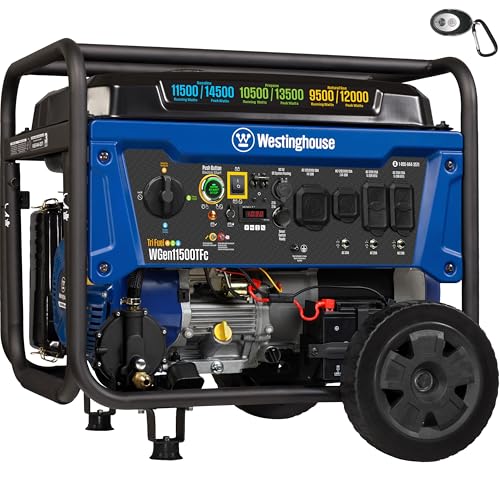
- 14,500 peak watts on gasoline
- Runs on gas, propane, or natural gas
- Transfer switch ready for home backup
Best For: Larger homes needing high-output backup power
Mid-Size Backup Value
6,600 Watt Dual Fuel Generator

- Transfer switch ready with L14-30R outlet
- Dual fuel: gasoline or propane
- Remote start plus CO sensor
Best For: Essential-circuit backup for smaller to mid-size homes
High-Capacity Tri-Fuel Backup
13,500 Peak Watt Home Generator

- 13,500 peak watts on gasoline
- Runs on gasoline, propane, or natural gas
- Transfer switch ready with RV outlet
Best For: Homes needing flexible, high-output backup power
Battery Backup System – 5040Wh Smart Transfer Switch Backup
If you want whole-home backup batteries with automatic transfer switches, this Jackery system is built for serious residential use. It combines a 5040Wh LiFePO4 power station with a 60A Smart Transfer Switch and dual-voltage output, so you can cover essential circuits and keep large appliances running during outages.
Best For: Homeowners who want a battery-based backup system for essential circuits and major appliances.
Pros:
- 7200W rated output with 14,400W surge for demanding appliances
- Supports both 120V and 240V, including up to 12 circuits at 120V or 6 at 240V with the smart transfer switch
- Expandable from 5040Wh up to 60kWh for longer outages
- Up to 4000W solar input with recharge in about 2 hours
Cons:
- Solar panels are optional, so full recharge capability depends on added equipment
- Requires pairing with the Jackery 60A Smart Transfer Switch for circuit integration
This is a strong fit if you want a battery backup that can do more than keep the lights on. The combination of high output, expandable storage, and fast solar charging makes it a flexible option for longer home outages.
Standby Generator – 14kW Home Backup With Transfer Switch
For buyers comparing whole-home backup batteries with automatic transfer switches against a fuel-powered alternative, this Honeywell standby generator offers a simpler always-ready approach. It includes a 16-circuit transfer switch and is designed for residential backup power with clean output and automatic self-testing.
Best For: Homeowners who want a fuel-powered standby backup with an included transfer switch for essential circuits.
Pros:
- 14kW output for residential backup needs
- Includes a 16-circuit transfer switch
- Less than 5% total harmonic distortion for cleaner power
- Quiet-Test self-test mode runs at lower RPM
Cons:
- Fuel-powered, so it requires natural gas or propane
- Not a battery backup system
This is a practical option if you want automatic backup with less focus on stored energy and more on generator-style uptime. The included transfer switch and low-distortion output make it a solid fit for home circuits and sensitive electronics.
Battery Bank Kit – 20.48kWh Split-Phase Backup Kit
If you are shopping for whole-home backup batteries with automatic transfer switches, this rack battery and inverter kit is aimed at serious off-grid or backup installations. It pairs 20.48kWh of LiFePO4 storage with an 8000W hybrid split-phase inverter, plus a built-in automatic transfer function rated at under 10ms for keeping critical devices online.
Best For: Homeowners or off-grid users who need a large battery bank with fast transfer switching and split-phase power.
Pros:
- 20.48kWh total storage from four 48V 100Ah batteries
- 8000W pure sine wave inverter with native 120/240V split phase output
- <10ms automatic transfer switching for sensitive electronics
- UL1973 batteries and UL1741 inverter certifications
Cons:
- More complex system than a single all-in-one portable backup unit
- Designed as a full kit, so installation and integration are more involved
This kit stands out for capacity, inverter output, and fast transfer performance. It is best suited to buyers who want a more scalable home energy system rather than a compact plug-and-play backup.
Transfer Switch Panel – 125A Whole-Home Backup Switch
For whole-home backup batteries with automatic transfer switches, the transfer switch itself matters just as much as the power source. This Nature’s Generator panel is designed to work with most solar generators and home battery backup systems, giving you automatic and manual control across a large circuit layout.
Best For: Homeowners who need a dedicated automatic transfer switch panel for a backup power system.
Pros:
- 125A switch with support for 30A, 50A, 100A, and 125A current ratings
- Works with 120V and 208V/240V systems
- 24 spaces expandable to 48 circuits with tandem breakers
- UL 508A, UL1008, and CSA certified
Cons:
- It is a transfer switch panel, not a battery or generator
- Installation is more involved than a simple plug-in backup device
This is the kind of component you choose when you already have or are planning a larger backup setup. Its broad compatibility, expandable circuit count, and weather-resistant enclosure make it a practical load-center solution.
Portable Transfer-Switch Backup – Westinghouse 12500W Dual Fuel Remote Start Generator
If you want a backup power solution that can feed a transfer switch, this Westinghouse generator is built for that job rather than for true battery-style operation. It fits the broader whole-home backup batteries with automatic transfer switches search intent by offering transfer-switch-ready output, remote electric start, and dual-fuel flexibility for outage planning.
Best For: Homeowners who want a portable dual-fuel generator with transfer-switch-ready output and remote start for outage backup.
Pros:
- Transfer switch ready with a 120V L14-30R 30A outlet.
- Remote start plus electric and recoil starting for easier use.
- Dual-fuel operation with 9,500 running watts on gasoline or 8,500 on propane.
- Up to 12 hours of run time on the 6.6-gallon tank.
Cons:
- It is a fuel-powered portable generator, not a battery backup system.
- Requires minimal assembly and routine fuel management.
This is a strong choice if you want portable backup power with the key compatibility features many shoppers look for in transfer-switch-ready setups. Its output, fuel options, and included remote key fob make it practical for home outage use without stepping into full standby territory.
Automatic Whole-House Standby – Generac 14kW Standby Generator with 200A ATS
For shoppers comparing whole-home backup batteries with automatic transfer switches, this Generac is the closest fit in the group because it is a permanent home standby generator with an automatic 200 amp transfer switch. It automatically detects an outage and restores backup power, making it a more hands-off option for whole-house protection.
Best For: Homeowners who want automatic whole-house backup power with built-in transfer switching and remote monitoring.
Pros:
- Includes an automatic 200 amp transfer switch for whole-home backup.
- Automatically detects outages and delivers backup power.
- Built-in cellular connectivity for Mobile Link monitoring and alerts.
- Compatible with Generac PWRcell battery systems and ecobee by Generac thermostats.
Cons:
- Fuel-powered standby unit, not a battery storage system.
- Large, heavy installation at 391 pounds.
If your priority is automatic operation rather than portable use, this model stands out for whole-house coverage and smart monitoring. The included transfer switch and outage detection make it a straightforward backup choice for homeowners who want minimal manual setup during an outage.
Mid-Size Backup Generator – Westinghouse 6600W Remote Start CO Generator
This Westinghouse model is a practical pick for buyers researching whole-home backup batteries with automatic transfer switches but who are open to a fuel-powered alternative. It is transfer-switch ready, has remote electric start, and adds a CO sensor for safer residential backup use during outages.
Best For: Homeowners who want a smaller transfer-switch-ready generator with remote start and long runtime.
Pros:
- Transfer switch ready with a 120/240V L14-30R 30A receptacle.
- Remote key fob and electric push-button start.
- Up to 14.5 hours of run time from the 4.7-gallon tank.
- Includes CO shutdown plus RV-ready and household outlets.
Cons:
- Fuel-powered generator rather than a battery backup system.
- Lower running wattage than larger whole-home options at 5,300 watts.
This is a solid middle-ground choice if you need backup power with transfer-switch compatibility but do not need a full standby installation. Its long runtime, remote start, and carbon monoxide shutdown make it especially appealing for practical home outage coverage.
Whole-Home Heavy-Duty Backup – 14,500 Peak Watt Tri-Fuel Generator
If you’re comparing whole-home backup batteries with automatic transfer switches, this generator is a practical high-output alternative for larger homes that want transfer-switch-ready backup power. It runs on gasoline, propane, or natural gas, and its low-THD design is intended to be safe for sensitive electronics like phones, computers, and TVs during outages.
Best For: Larger homes that need high running wattage and the flexibility of tri-fuel operation.
Pros:
- 14,500 peak watts and 11,500 running watts on gasoline for substantial backup capacity
- Tri-fuel setup lets you choose gasoline, propane, or natural gas
- Transfer switch ready for home backup installations
- Up to 19 hours of runtime on a 9.5-gallon tank
Cons:
- At 230 pounds, it is heavy and not designed for easy portability
- Open-frame design is more utilitarian than compact backup-battery systems
- Needs fuel storage or a gas line, depending on how you use it
This is the strongest option in the group for homeowners who want more output and fuel flexibility than a typical battery backup system can provide. If your priority is keeping major circuits powered through a transfer switch, this unit offers a straightforward, high-capacity path.
Mid-Size Backup Value – 6,600 Watt Dual Fuel Generator
For shoppers comparing whole-home backup batteries with automatic transfer switches, this dual-fuel generator is a more modest backup option for essential loads. It is transfer-switch ready, includes a remote electric start, and can run on either gasoline or propane, making it easier to match to a simple home-backup setup.
Best For: Homes that want a transfer-switch-ready backup source for key circuits without moving up to a very large generator.
Pros:
- Transfer switch ready with a 120/240V L14-30R receptacle
- Dual-fuel operation for gasoline or propane
- Remote key fob and push-button electric start
- CO sensor and automatic low-oil shutdown add protection
Cons:
- Lower output than the larger units in this roundup
- Best suited to essential circuits rather than whole-house loads
- 4.7-gallon tank is smaller than the higher-capacity models here
This model makes sense if you want a simpler backup system that still connects cleanly through a transfer switch. It is a balanced pick for powering critical appliances and keeping the setup more compact than a larger home generator.
High-Capacity Tri-Fuel Backup – 13,500 Peak Watt Home Generator
If you’re weighing whole-home backup batteries with automatic transfer switches, this tri-fuel generator stands out for its high output and direct transfer-switch-ready design. It offers gasoline, propane, and natural gas operation, plus a 50A RV-ready outlet and remote start for a more flexible home-backup setup.
Best For: Homeowners who want strong backup capacity and the option to run on natural gas, propane, or gasoline.
Pros:
- 13,500 peak watts and 10,500 running watts on gasoline
- Tri-fuel operation adds fuel flexibility for outages
- Transfer switch ready with multiple outlet options
- Remote start, electric start, and recoil start included
Cons:
- Large 230-pound unit is not easy to move around
- Open-frame design takes up more space than compact backup systems
- Fuel-based setup requires planning for storage or gas-line access
This is a strong fit if you want high-output backup with more fuel choices than a single-fuel generator. For homeowners who prioritize transfer-switch compatibility and long runtime, it offers a practical middle ground between smaller backup units and the biggest whole-home models.
How We Picked the Best Whole-Home Backup Batteries with Automatic Transfer Switches
We prioritized systems that can support meaningful home loads, switch automatically during outages, and fit real-world backup needs. That includes output capacity, transfer-switch compatibility, runtime or storage size, fuel flexibility for generators, and installation complexity. We also looked for options that are easier to integrate with whole-home electrical panels and backup circuits.
Quick Comparison
In this group, battery systems are best for quiet operation, instant switching, and low maintenance, while generator-based systems are better for long outages and extended runtime. Some models are designed as full home standby solutions, while others are portable or semi-portable units that can still work with a transfer switch for selected loads or broader coverage.
Key Buying Factors for Whole-Home Backup Batteries with Automatic Transfer Switches
Power Output and Starting Loads
Check both continuous wattage and surge capacity. Whole-Home Backup Batteries with Automatic Transfer Switches need enough headroom for HVAC, well pumps, refrigerators, sump pumps, and other motor-driven appliances.
Battery Capacity or Fuel Runtime
For batteries, look at usable kilowatt-hours rather than just nameplate size. For generators, estimate runtime at realistic loads and think about how often you can refuel during extended outages.
Transfer Switch Type
Automatic transfer switches restore power faster and with less hassle than manual switches. Make sure the transfer equipment is correctly sized for your panel, service rating, and the circuits you want backed up.
Installation and Electrical Compatibility
Whole-home systems often require professional installation, especially when connecting to a service entrance or integrating with a home backup panel. Confirm voltage support, split-phase compatibility, and whether the system is intended for whole-home or selected-circuit backup.
Noise, Fuel, and Maintenance
Battery systems are quiet and low maintenance. Generators need fuel planning, periodic servicing, and safe placement. Dual-fuel and tri-fuel models add flexibility, while standby units simplify daily use.
Who Should Buy Which Whole-Home Backup Batteries with Automatic Transfer Switches?
Choose a battery-based setup if you want silent operation, indoor-adjacent flexibility, and minimal maintenance. Choose a standby generator if you need long runtime and stronger coverage during multi-day outages. Choose a portable or transfer-switch-ready generator if you want lower upfront cost, flexible fuel options, or backup power that can also serve travel, jobsite, or RV use. If your goal is dependable whole-home coverage, focus first on load demands, then match the backup source and transfer equipment to your home’s actual electrical needs.
