

Smart homes depend on steady Wi-Fi for cameras, speakers, TVs, lights, and hubs. A strong mesh system can smooth out dead zones and keep everything connected as you move through the house.
Below, we focus on options that balance coverage, speed, app control, and support for lots of connected devices, so you can choose the right fit for your home and budget.
Best 10 Mesh WiFi Systems for Smart Homes Picks for 2026
6E Performance Pick
TP-Link Deco XE75 AXE5400 Tri-Band WiFi 6E System

- Covers up to 7,200 sq. ft.
- Tri-band with 6 GHz band and AI-driven mesh.
- Supports up to 200 devices and Alexa guest Wi-Fi.
Best For: Large smart homes that want 6E speed and strong coverage.
Smart Hub Value Pick
Amazon eero 6+ Mesh WiFi System

- Supports gigabit plans and 75+ devices.
- Built-in Thread and Zigbee smart home hub.
- TrueMesh helps reduce dead spots and drop-offs.
Best For: Smart homes that want easy setup plus built-in hub support.
WiFi 7 Upgrade Pick
TP-Link Deco BE25 WiFi 7 Mesh System

- WiFi 7 dual-band with up to 5,000 Mbps.
- Covers up to 6,600 sq. ft. and 150+ devices.
- Includes 2.5G ports, wired backhaul, and AI-Roaming.
Best For: Future-ready smart homes that want WiFi 7 and wired backhaul.
Simple Setup Pick
Google WiFi AC1200 Mesh WiFi System

- 3-pack covers up to 4,500 sq. ft.
- Google Home app simplifies setup and control.
- Includes guest networks and parental controls.
Best For: Easy whole-home Wi-Fi with straightforward app management.
Wi-Fi 7 Value Pick
TP-Link Deco 7 BE23 Dual-Band Mesh

- Wi-Fi 7 with MLO and 4K-QAM
- Up to 6,500 sq. ft. coverage
- Two 2.5G ports per node
Best For: Larger smart homes needing Wi-Fi 7 coverage and wired backhaul
Budget High-Capacity Mesh

- Up to 7,000 sq. ft. with 3-pack
- Wi-Fi 6 AX3000 up to 3,000 Mbps
- Supports 200+ devices and Ethernet backhaul
Best For: Large households wanting affordable Wi-Fi 6 mesh coverage
Premium Future-Proof Mesh
TP-Link Deco 7 Pro BE63 Tri-Band

- Tri-band Wi-Fi 7 with 10 Gbps-class speeds
- Covers up to 5,800 sq. ft. for 200+ devices
- Four 2.5G ports plus USB 3.0
Best For: Performance-focused smart homes needing tri-band Wi-Fi 7
Top Pick for Large Smart Homes
TP-Link Deco X55 AX3000 WiFi 6 Mesh System

- Covers up to 6,500 sq. ft.
- Supports up to 150 devices
- 3 Gigabit ports per unit with Ethernet backhaul
Best For: Large smart homes needing broad Wi-Fi 6 coverage and lots of connected devices
Best Budget-Friendly Whole-Home Kit
TP-Link Deco X15 AX1500 Mesh Wi-Fi
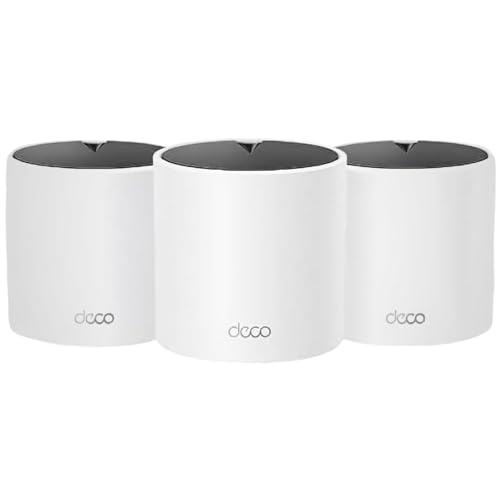
- Covers up to 5,600 sq. ft.
- Supports up to 120 devices
- 2 Gigabit ports per unit with wired backhaul
Best For: Value-focused smart homes that need reliable coverage and simple setup
Best 2-Pack for Smaller Homes
TP-Link Deco X55 AX3000 Mesh System

- Covers up to 4,500 sq. ft.
- Supports up to 150 devices
- 3 Gigabit ports per unit with Ethernet backhaul
Best For: Smaller smart homes that want AX3000 performance in a 2-pack
6E Performance Pick – TP-Link Deco XE75 AXE5400 Tri-Band WiFi 6E System
Among mesh WiFi systems for smart homes, the TP-Link Deco XE75 stands out if you want strong whole-home coverage plus the benefits of the 6 GHz band. It’s built to reduce interference, support lots of devices, and keep roaming smooth as you move from room to room.
Best For: Smart homes that need fast, low-interference Wi-Fi across a large space.
Pros:
- Covers up to 7,200 sq. ft. with a 3-pack.
- Tri-band design includes a brand-new 6 GHz band that can help reduce interference.
- AI-driven mesh learns your network environment for smoother roaming.
- Supports up to 200 devices and works with Alexa for guest Wi-Fi voice control.
Cons:
- A modem is required for most internet service providers.
- Best benefits come from WiFi 6E-compatible devices using the 6 GHz band.
If your priority is a modern mesh setup that can handle many connected devices while keeping dead zones down, the XE75 is one of the strongest all-around options here. Its security features and easy app management make it especially practical for busy households.
Smart Hub Value Pick – Amazon eero 6+ Mesh WiFi System
The Amazon eero 6+ is a practical choice in mesh WiFi systems for smart homes when you want reliable coverage without paying for top-tier premium specs. It’s designed for gigabit plans, includes a built-in smart home hub, and focuses on easy setup and steady day-to-day performance.
Best For: Families who want dependable mesh Wi-Fi with built-in smart home hub support.
Pros:
- Supports internet plans up to a gigabit.
- Coverage reaches up to 4,500 sq. ft. and supports 75+ devices.
- Built-in Thread and Zigbee smart home hub works with Alexa.
- TrueMesh technology intelligently routes traffic to reduce dead spots.
Cons:
- Coverage is lower than some larger 3-pack mesh systems.
- Advanced security and network management features may require a separate subscription.
For households that value simplicity and smart home convenience, the eero 6+ hits a very useful middle ground. It’s especially appealing if you want one system that helps Wi-Fi and smart devices work together cleanly.
WiFi 7 Upgrade Pick – TP-Link Deco BE25 WiFi 7 Mesh System
If you’re shopping mesh WiFi systems for smart homes and want a newer standard, the TP-Link Deco BE25 brings WiFi 7 features into an easy whole-home package. It combines strong coverage, 2.5G ports, and AI-Roaming so the network can stay stable as your devices move around the house.
Best For: Smart homes that want WiFi 7 features, wired backhaul options, and future-ready networking.
Pros:
- WiFi 7 dual-band system delivers up to 5,000 Mbps.
- Covers up to 6,600 sq. ft. and supports over 150 devices.
- Includes two 2.5G ports and supports wired backhaul.
- AI-Roaming, VPN support, and HomeShield add useful smart-home networking tools.
Cons:
- Requires at least two units to use backhaul.
- A modem is required for most internet service providers.
The BE25 is a strong fit if you want a mesh system that feels more future-focused than WiFi 6 or 6E models. It’s particularly attractive for larger homes that can benefit from faster wired connections between nodes.
Simple Setup Pick – Google WiFi AC1200 Mesh WiFi System
The Google WiFi AC1200 is a straightforward option for mesh WiFi systems for smart homes when you want simple setup and steady whole-home coverage. It’s a 3-pack bundle designed to keep the network organized while delivering a clean signal across a typical family home.
Best For: Buyers who want an easy-to-manage mesh system with reliable everyday coverage.
Pros:
- 3-pack covers up to 4,500 sq. ft.
- Google Home app makes setup and management simple.
- Supports guest networks and parental controls.
- Designed to keep signal performance stable with no dead zones or drop-offs.
Cons:
- Uses Wi-Fi 5 instead of newer WiFi 6 or WiFi 7 standards.
- Not smart home compatible according to the listed product details.
This is the most basic pick in the group, but that can be exactly what some households need. If you care more about simple app management and dependable coverage than cutting-edge specs, it’s an easy system to live with.
Wi-Fi 7 Value Pick – TP-Link Deco 7 BE23 Dual-Band Mesh
If you want mesh WiFi systems for smart homes that can keep up with newer devices, the TP-Link Deco 7 BE23 is built around Wi-Fi 7, AI-Roaming, and strong wired support. It’s a practical fit for households that need broad coverage, stable backhaul options, and security tools without complicating setup.
Best For: Larger smart homes that want Wi-Fi 7 performance, multi-gig ports, and easy whole-home coverage.
Pros:
- Wi-Fi 7 with MLO, Multi-RUs, and 4K-QAM for newer compatible devices
- Covers up to 6,500 sq. ft. and supports up to 150 devices
- Two 2.5 Gbps WAN/LAN ports per unit for wired backhaul and fast wired gear
- HomeShield, WPA3, IoT network separation, and VPN support add useful security options
Cons:
- Dual-band design may be less flexible than a tri-band mesh for very heavy traffic
- Some advanced benefits depend on Wi-Fi 7 devices and a multi-gig internet setup
- A modem is required for most internet providers
Overall, this Deco 7 BE23 package is a strong all-around pick if you want a modern mesh network that balances speed, coverage, and smart-home security. It looks especially appealing for homes that plan to grow into Wi-Fi 7.
Budget High-Capacity Mesh – Cudy AX3000 WiFi 6 Mesh
The Cudy AX3000 is a straightforward option among mesh WiFi systems for smart homes if you want wide coverage and strong device support without moving up to Wi-Fi 7. It’s designed to replace a router and extender setup, and it leans on Wi-Fi 6, Ethernet backhaul, and app-based setup to keep the network simple.
Best For: Big households that want affordable Wi-Fi 6 mesh coverage for many devices.
Pros:
- Covers up to 7,000 sq. ft. with a 3-pack
- Wi-Fi 6 AX3000 dual-band system supports up to 3,000 Mbps
- Each unit includes a 2.5G WAN port and supports wired Ethernet backhaul
- Built for 200+ devices with app-based setup and management
Cons:
- Wi-Fi 6 is less future-focused than Wi-Fi 7 systems
- Only one 2.5G WAN port per unit, with gigabit LAN
- Features are more basic than premium tri-band mesh options
This is the kind of mesh kit that makes sense when coverage and capacity matter more than cutting-edge wireless features. For smart-home use, it offers a useful mix of range, wired backhaul, and easy control.
Premium Future-Proof Mesh – TP-Link Deco 7 Pro BE63 Tri-Band
For mesh WiFi systems for smart homes that need top-end speed and more headroom, the TP-Link Deco 7 Pro BE63 is the most ambitious option here. Its tri-band Wi-Fi 7 design, 10Gbps-class performance, and 4x 2.5G ports are aimed at homes with lots of connected devices, fast internet service, and demanding streaming or gaming.
Best For: Performance-focused smart homes that want tri-band Wi-Fi 7 and multi-gig wired networking.
Pros:
- Tri-band Wi-Fi 7 with up to 10 Gbps-class combined speeds
- 2-pack covers up to 5,800 sq. ft. and supports over 200 devices
- Four 2.5G WAN/LAN ports plus USB 3.0 for flexible wired networking
- AI-Roaming, HomeShield, VPN support, and smart-home compatibility
Cons:
- More expensive and capable than many households actually need
- Some performance claims depend on conditions, distance, and obstacles
- Backhaul requires at least two Deco units to take advantage of mesh features
If your smart home depends on fast, stable wireless across many rooms, this Deco system is built to handle that load. It’s a strong choice when you want more than just basic whole-home coverage and expect your network to keep growing.
Top Pick for Large Smart Homes – TP-Link Deco X55 AX3000 WiFi 6 Mesh System
For mesh WiFi systems for smart homes, the TP-Link Deco X55 is built to handle a lot of connected gear while keeping coverage simple to manage. This Wi-Fi 6 mesh system covers up to 6,500 square feet, supports up to 150 devices, and adds Ethernet backhaul plus three Gigabit ports on each unit for more flexible placement.
Best For: Larger smart homes that need broad Wi-Fi 6 coverage, lots of device capacity, and wired backhaul support.
Pros:
- Wi-Fi 6 AX3000 performance with coverage up to 6,500 sq. ft.
- Supports up to 150 devices, which is helpful for smart-home-heavy setups.
- Three Gigabit Ethernet ports per unit and Ethernet backhaul support.
- Deco app setup and HomeShield security features included.
Cons:
- Dual-band design may be less ideal than tri-band systems for very demanding networks.
- Modem is required for most internet service providers.
If you want a strong all-around mesh WiFi system that can cover a big home and keep many devices online, the Deco X55 is an easy fit. Its mix of wide coverage, wired backhaul, and app-based control makes it practical for everyday smart-home use.
Best Budget-Friendly Whole-Home Kit – TP-Link Deco X15 AX1500 Mesh Wi-Fi
The TP-Link Deco X15 is a straightforward choice if you want mesh WiFi systems for smart homes without paying for more speed than you need. It delivers Wi-Fi 6 AX1500 coverage up to 5,600 square feet, supports up to 120 devices, and includes Ethernet backhaul plus two Gigabit ports per unit for flexible home networking.
Best For: Value-focused smart homes that need reliable whole-home coverage and easy app-based control.
Pros:
- Wi-Fi 6 AX1500 mesh system with coverage up to 5,600 sq. ft.
- Supports up to 120 devices, enough for many smart-home setups.
- Two Gigabit Ethernet ports per unit and wired backhaul support.
- Deco app setup, remote management, and Alexa/Google Assistant support.
Cons:
- Lower AX1500 class is less powerful than the Deco X55’s AX3000 performance.
- Dual-band design may not be the best match for very traffic-heavy networks.
For most households, the Deco X15 covers the essentials well: broad coverage, easy setup, and enough capacity for connected devices. It stands out as a practical pick when you want a capable smart-home mesh system at a simpler performance tier.
Best 2-Pack for Smaller Homes – TP-Link Deco X55 AX3000 Mesh System
If you need mesh WiFi systems for smart homes in a smaller footprint, the 2-pack Deco X55 gives you the same Wi-Fi 6 AX3000 platform in a more compact kit. It covers up to 4,500 square feet, supports up to 150 devices, and includes three Gigabit ports per unit plus Ethernet backhaul support for better wired performance.
Best For: Smaller smart homes or apartments that still want strong device support and premium Wi-Fi 6 features.
Pros:
- Wi-Fi 6 AX3000 performance with coverage up to 4,500 sq. ft.
- Supports up to 150 devices, useful for connected smart-home gear.
- Three Gigabit Ethernet ports per unit and Ethernet backhaul support.
- Deco app control, HomeShield security, and AI-driven mesh optimization.
Cons:
- 2-pack covers less area than the 3-pack version.
- Dual-band design may not suit very dense or ultra-high-demand networks.
This is a strong option when you like the X55 feature set but do not need the larger 3-pack coverage. It balances smart-home capacity, flexible wired connectivity, and easier sizing for smaller homes.
How We Picked the Best Mesh WiFi Systems for Smart Homes
We looked for systems that are practical for multi-device households, with enough coverage for typical homes, modern Wi-Fi standards, and features that reduce setup friction. For mesh Wi-Fi systems for smart homes, stability matters as much as speed, so we favored models with strong backhaul options, good app management, and enough Ethernet ports for hubs, consoles, or streaming gear.
Quick Comparison: What Matters Most
Not every home needs the fastest Wi-Fi 7 model. Smaller homes or apartments may do well with a simpler Wi-Fi 6 or dual-band system, while larger homes and heavier users may benefit from tri-band or Wi-Fi 7 options. If you have many smart devices, look beyond raw speed and pay attention to device capacity, coverage claims, and wired connectivity.
Key Buying Factors for Mesh Wi-Fi Systems for Smart Homes
Coverage and Layout
Start with your floor plan, not the package rating alone. Thick walls, multiple floors, basements, and garages can reduce real-world range. Choose a system with a little extra coverage headroom so the satellite nodes can be placed more flexibly.
Wi-Fi Standard and Band Design
Wi-Fi 6 remains a strong value for most households, especially if your internet plan is moderate and your smart devices are mostly low-bandwidth. Wi-Fi 6E and Wi-Fi 7 add more spectrum and can improve performance in busy homes. Tri-band systems often handle backhaul better, which helps maintain speed across multiple nodes.
Device Load and Smart Home Stability
Many smart homes include dozens of connected devices, but not all of them use bandwidth equally. Prioritize systems that are known to handle many clients reliably, especially if you use security cameras, streaming devices, and voice assistants at the same time.
Ports, Backhaul, and Wired Flexibility
If you can wire nodes together, that can improve consistency. Look for 2.5G ports if you have multi-gig internet or want more future-proofing, and make sure each unit has enough Ethernet ports for your setup.
Who Should Buy Which Mesh WiFi Systems for Smart Homes?
If you want an easy, dependable upgrade for an average home, a Wi-Fi 6 mesh system is often the safest value choice. If your home is large, crowded with devices, or you want better long-term headroom, consider Wi-Fi 6E or Wi-Fi 7. If your priority is simple setup and app-based control, look for systems with straightforward onboarding and automatic network management. For power users with wired devices and fast internet, choose a model with multi-gig ports and strong backhaul support.
In short, the best mesh Wi-Fi systems for smart homes are the ones that match your layout, device count, and internet speed without overbuying features you will not use.
