

Smart electrical panel energy monitors help you see where electricity is really going, so you can cut waste, manage solar, and track major loads with confidence.
Below, we’ve rounded up 10 standout options for homes, rentals, and light commercial setups, with a focus on accuracy, app experience, and installation flexibility.
Best 10 Smart Electrical Panel Energy Monitors Picks for 2026
Whole-Home Monitoring
Emporia Vue 3 Home Energy Monitor
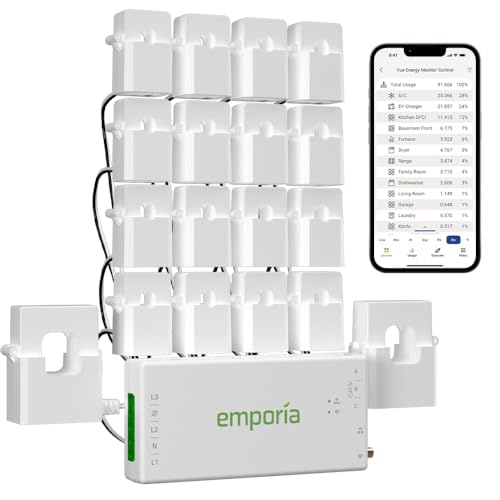
- UL Listed for safer panel installation
- Sixteen branch sensors for circuit monitoring
- Supports solar and net metering in the app
Best For: Homeowners wanting detailed, safety-certified whole-home tracking
Panel-Level Detail
SIEMENS Inhab Smart Home Energy Monitor

- Tracks mains plus up to 16 branch circuits
- App shows real-time and historical usage
- Adds alerts plus solar and demand management
Best For: Users wanting detailed Siemens panel monitoring with advanced controls
Business-Grade 3-Phase
Emporia Vue 3 Commercial Monitor

- Made for small-business panel installations
- Supports select single-phase and 3-phase systems
- Tracks solar and net metering in real time
Best For: Small businesses needing multi-phase panel monitoring
Rental Home Circuit Monitor
Smart Home Energy Monitor with 16 Circuit Sensors

- 16 clamp-on 50A circuit sensors
- Tracks real-time usage and electricity cost
- Works with Home Assistant and MQTT
Best For: Landlords and shared homes needing circuit-level billing
UL-Certified Whole Home Monitor
Emporia Vue 3 Home Energy Monitor
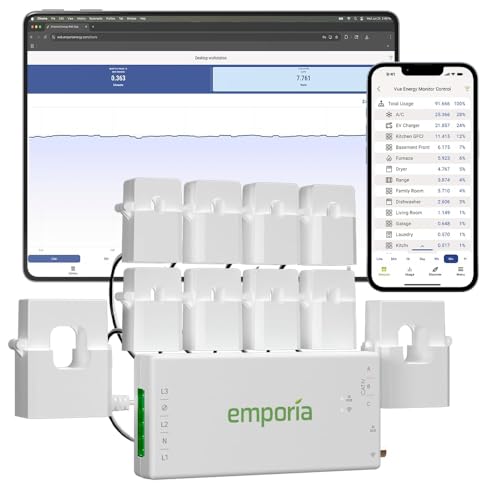
- UL Listed and CE Listed safety certification
- Whole-home and solar/net metering support
- App tools for time-of-use and peak-demand control
Best For: Homeowners who want certified, app-based energy monitoring
Privacy-Focused Circuit Monitor
Meross Smart Energy Consumption Monitor

- Tracks 18 circuits total with clamp-on sensors
- Local data, no subscriptions, Home Assistant support
- Smart alerts plus up to 5 years of data storage
Best For: Privacy-minded users and Home Assistant setups
Whole-Home Monitoring Bundle
Emporia Energy Monitor with 16 Sensors

- 16-sensor panel monitoring with second-by-second visibility
- Includes 4 smart plugs for device control and scheduling
- Supports solar net metering and app-based automation
Best For: Buyers who want whole-home monitoring plus smart plug control
Local Privacy Pro Monitor
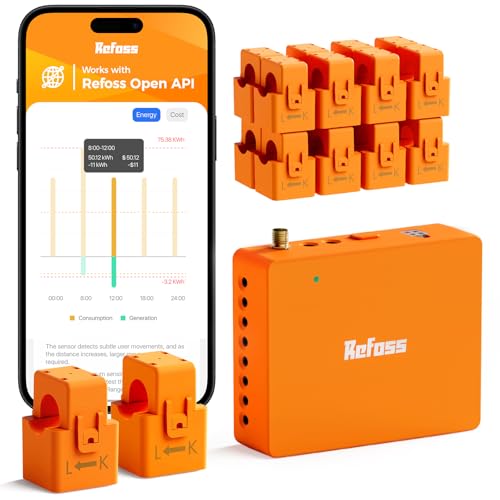
- Local Web UI and Open API with no cloud required
- 18-circuit monitoring with stated ±1% precision
- 5 years of data storage plus solar and smart alerts
Best For: Privacy-focused users who want local control and Home Assistant support
Local Automation Monitor
Refoss Native Home Assistant Energy Monitor

- Native Home Assistant support with no firmware flashing
- Local Web UI, Open API, and MQTT without cloud reliance
- Solar automation and circuit alerts for energy management
Best For: Home Assistant users who want local monitoring and solar optimization
Whole-Home Monitoring – Emporia Vue 3 Home Energy Monitor
If you’re comparing smart electrical panel energy monitors for whole-home visibility, the Emporia Vue 3 stands out for detailed panel-level tracking and solar/net metering support. It uses clamp-on sensors, works with most homes, and adds app-based energy management so you can watch usage in real time and spot savings opportunities.
Best For: Homeowners who want UL-listed panel monitoring with circuit-level insight and solar tracking.
Pros:
- UL Listed for added safety and peace of mind
- Includes sixteen 50A branch sensors for appliance and circuit monitoring
- Supports solar and net metering with real-time data in the app
- Works with 2.4 GHz Wi-Fi for iPhone, Android, and web access
Cons:
- Requires 2.4 GHz Wi-Fi and an internet connection
- Some 3-phase setups need an additional 200A sensor sold separately
- Advanced data retention varies by timeframe in the app and cloud
This is a strong fit if you want detailed electrical panel monitoring plus automation features without guessing where power is going. The combination of circuit sensors, solar support, and safety certification makes it especially practical for everyday energy management.
Solar-Friendly Tracking – Smart Home Energy Monitor with CTs
This smart electrical panel energy monitor is aimed at users who want accurate live usage tracking with solar-aware, bi-directional power measurement. With 2 x 120A CTs, app control, and configurable reporting, it focuses on practical monitoring and automation rather than a complicated install.
Best For: Solar and battery storage homes that need bi-directional monitoring and app-based automation.
Pros:
- Bi-directional monitoring measures both consumption and grid export
- Class 1 accuracy with configurable reporting intervals
- Pluggable terminals and split-core CTs simplify installation
- Works with Smart Life app features like alerts and automation scenes
Cons:
- Only listed for single-phase 3-wire systems
- Requires 2.4 GHz Wi-Fi
- Best features depend on app-based setup and integration
For households with solar or storage, the main appeal is seeing both power use and export clearly in one system. It’s a straightforward option when you want useful energy data, HEMS features, and a simpler installation path.
Panel-Level Detail – SIEMENS Inhab Smart Home Energy Monitor
If you want smart electrical panel energy monitors that combine whole-home and circuit-level visibility, the Siemens Inhab is built for that job. It tracks current and historical usage through the mobile app, supports up to 16 branch circuits, and adds energy management features like time-of-use and excess solar control.
Best For: Homeowners who want Siemens panel monitoring with detailed circuit insight and advanced energy controls.
Pros:
- Monitors both panel mains and up to 16 branch circuits
- Mobile app shows current and historical usage in real time
- Includes alerts for unusual behavior and energy-saving opportunities
- Supports time-of-use, peak demand, excess solar, and load shedding functions
Cons:
- USA and Canada only
- Installation is panel-based, so it’s not a plug-and-play product
- Advanced controls depend on compatible smart devices and setup
The Inhab is a good choice when you want more than a basic electricity monitor and need direct panel-level measurements. Its circuit sensors and management features make it especially useful for homes with solar, EV charging, or changing demand patterns.
Business-Grade 3-Phase – Emporia Vue 3 Commercial Monitor
For small businesses needing smart electrical panel energy monitors with 3-phase support, the Emporia Vue 3 Commercial is designed for panel-based usage tracking and automation. It installs with clamp-on sensors and covers single-phase, single-split phase, 2-wire systems, plus supported 3-wire and 3-phase wye setups with the right additional sensor.
Best For: Small businesses or multi-phase installations that need panel monitoring and solar/net metering support.
Pros:
- Built for small-business circuit panels with clamp-on sensors
- Supports single-phase and select 3-phase configurations
- Includes real-time electricity usage and power consumption tracking
- Works with solar and net metering use cases
Cons:
- Some 3-phase setups require an additional 200A sensor sold separately
- Does not include batteries
- Commercial-oriented setup may be more than a basic home user needs
This model is best when you need broader electrical panel coverage than a typical home monitor provides. Its support for more complex systems makes it a practical pick for business environments or homes with compatible multi-phase wiring.
Rental Home Circuit Monitor – Smart Home Energy Monitor with 16 Circuit Sensors
If you want smart electrical panel energy monitors for a rental or shared property, this SEM-Meter setup focuses on circuit-level visibility. It uses clamp-on sensors to track real-time usage and estimated cost across multiple rooms or appliances, with app history and Home Assistant support for more advanced local control. It’s a practical fit when you need to allocate electricity by circuit instead of relying on a single whole-home reading.
Best For: Landlords, rental homes, and shared apartments that need per-circuit billing visibility.
Pros:
- Includes 16 50A sensors for detailed branch-circuit monitoring.
- Supports real-time usage, cost tracking, and app history.
- Works with Home Assistant and can run via MQTT for local-only use.
- Handles solar/net metering and multi-phase installations.
Cons:
- Requires a Wi‑Fi setup and panel installation.
- Best privacy features depend on MQTT/Home Assistant use.
Overall, this is a strong choice if you need granular electrical monitoring and fair cost allocation across multiple circuits. Its biggest advantage is flexibility: it can support everyday tracking, solar use cases, and privacy-focused local setups.
UL-Certified Whole Home Monitor – Emporia Vue 3 Home Energy Monitor
The Emporia Vue 3 is a straightforward option if you’re comparing smart electrical panel energy monitors for whole-home tracking, solar monitoring, and app-based cost control. It installs with clamp-on sensors in many common panel types and provides real-time energy data through the Emporia app, with features aimed at time-of-use, peak demand, and excess solar management. The UL listing also adds reassurance for buyers who prioritize certified safety.
Best For: Homeowners who want a UL-listed monitor with app-based energy and solar tracking.
Pros:
- UL Listed and CE Listed for safety confidence.
- Supports whole-home monitoring plus solar/net metering.
- App tools help manage time-of-use and peak-demand costs.
- Provides real-time data with cloud retention for longer-term review.
Cons:
- Requires 2.4 GHz Wi‑Fi with an internet connection.
- Some panel types need extra sensor support sold separately.
This is a solid pick if safety certification matters as much as energy tracking. It balances simple whole-home monitoring with useful app controls, though buyers wanting fully local operation will want to look elsewhere.
Privacy-Focused Circuit Monitor – Meross Smart Energy Consumption Monitor
For buyers looking at smart electrical panel energy monitors with a local-data approach, the Meross monitor stands out for circuit-level tracking, Home Assistant support, and no-subscription use. It covers power, voltage, current, and power factor, while offering smart alerts and long data storage for deeper analysis. Its two-main-circuit plus 16-branch-circuit layout makes it well suited to homes that want detailed, practical oversight.
Best For: Home Assistant users and privacy-minded buyers who want detailed circuit monitoring without subscriptions.
Pros:
- Tracks 2 main circuits and 16 branch circuits.
- No subscriptions, no cloud lock-in, and local data storage.
- Home Assistant support with Open API and Web Control.
- ETL-certified, with UL 61010 testing-standard compliance and 2-year warranty.
Cons:
- Panel installation is required.
- Advanced automation is strongest for Home Assistant users.
Meross is a compelling choice if you want granular monitoring without giving up privacy. It combines detailed circuit visibility with automation-friendly features, making it a practical fit for energy-conscious homes and solar setups.
Whole-Home Monitoring Bundle – Emporia Energy Monitor with 16 Sensors
If you’re comparing smart electrical panel energy monitors for whole-home visibility, this Emporia bundle stands out for combining circuit-level tracking with outlet control. The included 16-sensor monitor gives second-by-second insight into usage from the main panel and up to 16 circuits, while the four smart plugs add per-outlet control for plugged-in devices. It also supports solar net metering and works with the Emporia app on iOS, Android, and Alexa.
Best For: Homeowners who want whole-home monitoring plus smart plug control in one bundle.
Pros:
- Tracks main panel usage and up to 16 individual circuits with 16 sensors
- Includes 4 Wi-Fi smart plugs for remote control, scheduling, and outlet-level energy tracking
- Supports solar net metering and time-of-use, peak demand, and rewards program automation
- Free app with cloud storage for anytime access on iOS and Android
Cons:
- Depends on the Emporia app and cloud storage for access
- May be more bundle than some buyers need if they only want panel monitoring
This is a strong pick if you want one of the more feature-rich smart electrical panel energy monitors with extras for everyday energy control. The added smart plugs make it especially useful for trimming standby waste and automating common devices.
Local Privacy Pro Monitor – Refoss 16x60A Energy Monitor
Among smart electrical panel energy monitors, this Refoss model is a good fit if local data control matters as much as circuit visibility. It monitors up to 18 circuits with stated ±1% precision, supports solar metering and utility optimization, and offers local web access with Open API, MQTT, and WebSocket support. For buyers who want detailed usage data without relying on the cloud, it keeps things straightforward.
Best For: Privacy-focused users who want local control, Home Assistant support, and circuit-level monitoring.
Pros:
- Local Web UI, Open API, MQTT, and WebSocket support without cloud dependence
- Monitors 2 main sensors and up to 16 branch sensors for 18-circuit visibility
- Stated ±1% precision with 5 years of daily data storage and CSV export
- Supports solar net metering, time-of-use optimization, and smart alerts
Cons:
- Advanced integrations may be more than casual users need
- Requires installation inside the breaker panel, so setup is not plug-and-play
This monitor is best when local privacy and home automation are the priorities. It offers a strong mix of detailed circuit reporting, solar-focused automation, and long-term data retention for deeper energy analysis.
Local Automation Monitor – Refoss Native Home Assistant Energy Monitor
If you want smart electrical panel energy monitors that work natively with your automation setup, this Refoss option is built around local control. It provides a built-in Web UI, Open API, and MQTT without cloud reliance, plus native Home Assistant support right out of the box. The monitor also focuses on solar self-consumption and circuit-level alerts, making it a practical choice for modern energy management.
Best For: Home Assistant users who want local monitoring, automation, and solar optimization.
Pros:
- Native Home Assistant integration with no firmware flashing required
- Local control via Web UI, Open API, and MQTT without cloud services
- Supports solar automation to route surplus power to appliances and reduce feed-in
- Stated ±1% accuracy with 5 years of daily data storage and export
Cons:
- Installation inside the panel still requires electrical work
- Best features are most useful if you already use Home Assistant or MQTT
This is a compelling pick for users who want local-first monitoring with strong smart-home integration. Its mix of circuit alerts, solar scheduling, and long-term data makes it especially useful for ongoing efficiency tuning.
How We Picked These Smart Electrical Panel Energy Monitors
We prioritized panel monitors that offer clear real-time usage data, practical installation options, and features that match common buyer needs. We also looked for models with strong circuit coverage, main-meter support, solar compatibility, local storage or open APIs where relevant, and useful app-based reporting.
Because Smart Electrical Panel Energy Monitors can vary a lot by electrical layout, we included options for single-phase homes, whole-home monitoring, three-phase applications, and users who want smart plugs or web-based access alongside panel data.
Quick Comparison
For most homeowners, a whole-home monitor with main CT clamps is the easiest starting point. If you want room-by-room or circuit-level insight, choose a monitor with enough branch sensors for your panel. If you manage solar or a more complex service type, look for bi-directional tracking, multi-phase support, and solid historical reporting.
Key Buying Factors for Smart Electrical Panel Energy Monitors
Panel Compatibility
Check whether your service is single-phase, split-phase, or three-phase, and confirm the monitor supports your breaker panel size and main amperage. Some systems are designed for standard residential panels, while others are better suited to commercial or higher-capacity setups.
Monitoring Depth
Decide whether you only need whole-home data or detailed circuit-level monitoring. More CT sensors usually mean better visibility, but they also increase install complexity and cost.
Solar and Bi-Directional Tracking
If you have solar, prioritize a monitor that can separate consumption from export so you can measure net usage accurately and understand production patterns.
Data Access and Storage
App dashboards are useful for daily checks, but power users may want local data storage, open API support, or a web UI for more flexible analysis and privacy.
Installation and Expansion
Look at whether the system uses clamp-on CT sensors, includes enough channel capacity for future expansion, and supports smart plugs or extra modules if you want appliance-level detail without adding more panel sensors.
Who Should Buy Which Smart Electrical Panel Energy Monitors?
If you want a simple whole-home view, choose a monitor with main CT clamps and straightforward app setup. If you’re trying to identify specific energy hogs, pick a circuit-level system with enough sensors for the loads you care about most. If you own a rental property or need broader insight across multiple circuits, a higher-channel monitor is usually the better fit. And if privacy, automation, or integration matter most, favor Smart Electrical Panel Energy Monitors with local access, open APIs, or strong automation support.
