

Choosing the right energy monitor can make solar ownership far easier to manage. The best options help you track consumption, watch solar surplus, and spot wasted power before it turns into a bigger bill.
Below, we focus on smart home energy monitors compatible with solar panels that offer practical visibility, reliable data access, and the wiring support buyers actually need.
Best 10 Smart Home Energy Monitors Compatible with Solar Panels Picks for 2026
UL-Listed Whole-Home Monitoring
Emporia Vue 3 Home Energy Monitor
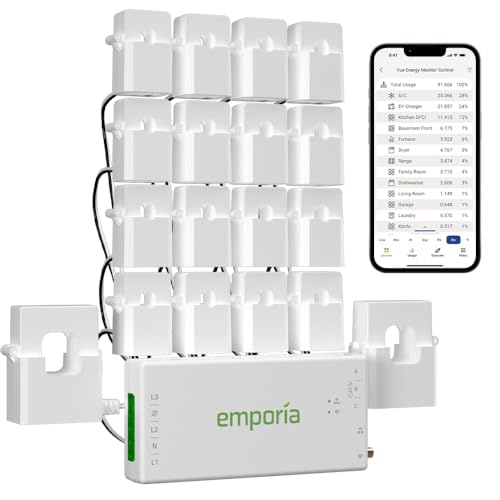
- UL Listed for safer home installation
- Tracks solar and net metering in the app
- Includes 16 branch sensors for circuit monitoring
Best For: Homeowners wanting safe, whole-home solar-aware monitoring
DIN-Rail Solar Metering

- Tracks produced and used energy on three phases
- Wi-Fi, LAN, and Bluetooth gateway support
- Monitors solar panels with up to 60 days of data
Best For: Solar owners wanting a wired 3-phase meter with two-way tracking
Panel-Level Solar Management
SIEMENS Inhab Smart Home Energy Monitor

- Tracks mains and up to 16 branch circuits
- Includes excess solar and net metering features
- UL Listed and CE marked for US and Canada
Best For: US and Canada buyers needing circuit-level solar management
Whole-Home Solar Auditing
Refoss 16-Circuit Local Data Monitor
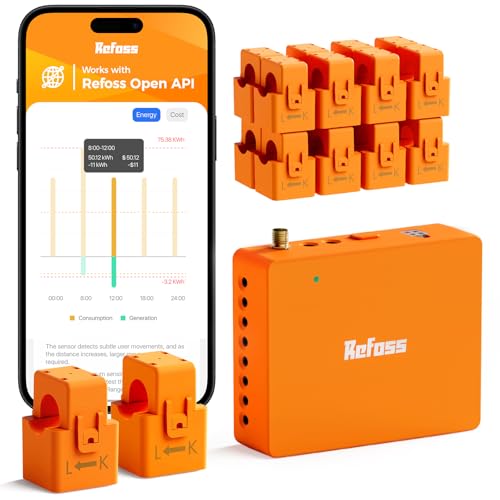
- 18-circuit monitoring with ±1% precision
- Local control via web UI, Open API, MQTT
- Solar surplus optimization and 5-year logs
Best For: Privacy-focused homeowners with solar who want detailed circuit analytics
Simple Solar + Grid Monitoring

- Tracks import/export and solar generation
- Supports split-phase, single-phase, and three-phase
- Free mobile apps with optional APIs
Best For: Users who want simple solar monitoring with flexible phase support
Local Solar Surplus Control
Meross 18-Circuit Energy Monitor

- 18-circuit monitoring with ±2% accuracy
- Solar surplus detection with Home Assistant support
- Local data storage and no subscriptions
Best For: Solar homes that want local automation and detailed usage alerts
Whole-Home Solar Net Metering Monitor

- Supports grid, solar, or net metering
- Includes two 200A sensors and no-subscription cloud access
- Shows usage in dollars, watts, amps, and volts
Best For: Homeowners and solar users who want simple whole-home monitoring
Panel-Level Circuit Tracker
WiFi Home Energy Monitor with 3 CT Clamps
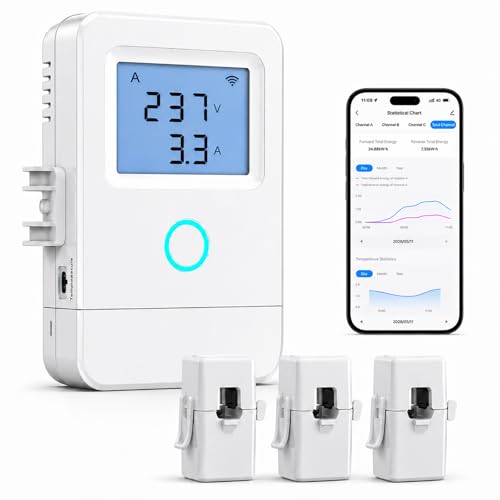
- Monitors up to 3 selected circuits
- Works with Smart Life/Tuya app over 2.4GHz WiFi
- Tracks solar-related circuits plus HVAC and water heater loads
Best For: DIY homeowners who want app-based circuit monitoring
Local Control Solar Automation Monitor
Refoss Smart Home Energy Monitor

- Local web UI, Open API, and MQTT with no cloud required
- Native Home Assistant integration and OpenClaw AI support
- Built for solar self-consumption and automation
Best For: Privacy-focused solar homes that want local automation
UL-Listed Whole-Home Monitoring – Emporia Vue 3 Home Energy Monitor
If you want smart home energy monitors compatible with solar panels for whole-home visibility, the Emporia Vue 3 is built around real-time usage tracking and solar / net metering. It installs in most home circuit panels with clamp-on sensors and gives you app-based energy data for managing costs, peak demand, and excess solar.
Best For: Homeowners who want UL-listed panel monitoring with solar and net metering support.
Pros:
- UL Listed and CE Listed for safety and reliability.
- Monitors solar / net metering and supports time-of-use and peak demand management.
- Includes sixteen 50A branch sensors for circuit-level appliance monitoring.
- Works with iPhone, Android, and web app over 2.4 GHz Wi-Fi.
Cons:
- Requires 2.4 GHz Wi-Fi with an internet connection.
- Some system types need an additional 200A sensor sold separately.
- 1-second data is only available in the app while actively open.
Overall, the Vue 3 is a strong pick if you want safety-certified monitoring with detailed branch-circuit visibility and solar-aware energy management.
DIN-Rail Solar Metering – Shelly Pro 3EM 120A
Among smart home energy monitors compatible with solar panels, the Shelly Pro 3EM focuses on accurate three-phase measurement and two-way consumption tracking. It uses Wi-Fi and LAN, supports the Shelly Smart Control app, and can show how much energy your solar panels or wind turbines generate with historical data up to 60 days.
Best For: Users who need a DIN-mountable 3-phase meter with solar generation tracking and wired networking.
Pros:
- Measures three-phase energy with 1% active energy accuracy.
- Tracks 2-way consumption: produced and used energy.
- Supports solar panel or wind turbine monitoring with up to 60 days of history.
- Offers Wi-Fi, LAN, Bluetooth gateway, and no-hub operation.
Cons:
- Built as a DIN-rail, 3-phase device, so it may not suit simpler single-phase setups.
- Monitoring depth is focused on energy measurement rather than broad appliance sensing.
If you want a wired-friendly solar meter with strong two-way tracking and smart home compatibility, the Pro 3EM is a practical choice.
Panel-Level Solar Management – SIEMENS Inhab Smart Home Energy Monitor
The SIEMENS Inhab is a good fit if you’re comparing smart home energy monitors compatible with solar panels and want direct panel-level measurement. It tracks whole-home and up to 16 branch circuits in real time, and its app-based alerts and advanced energy functions include excess solar management and net metering.
Best For: Buyers who want circuit-level monitoring plus solar-oriented energy features in one UL-listed monitor.
Pros:
- Measures energy directly at the mains and for up to 16 branch circuits.
- Supports excess solar management, net metering, and time-of-use management.
- Includes personalized notifications for unusual usage and savings opportunities.
- UL Listed and CE marked for US and Canada.
Cons:
- Designed for USA and Canada only.
- Installation requires working in the electrical panel.
For shoppers who want solar-aware features and detailed circuit monitoring from a mainstream brand, the Inhab stands out as a capable whole-home option.
Bi-Directional Solar Tracking – Smart Home Energy Monitor WiFi Version
If your priority is smart home energy monitors compatible with solar panels and battery storage, this model is built for bi-directional power tracking. It measures both household consumption and power export to the grid with Class 1 accuracy, while also supporting Smart Life app automation and HEMS features like dynamic load balancing and zero grid export mode.
Best For: Solar and battery-storage homeowners who want export tracking and app-based automation.
Pros:
- Bi-directional monitoring tracks both usage and grid export.
- Class 1 accuracy for solar system energy measurement.
- Supports Smart Life app scenes, alerts, and home automation.
- Includes HEMS features such as dynamic load balancing and zero grid export mode.
Cons:
- Limited to a single-phase 3-wire system.
- Uses 2.4 GHz Wi-Fi only.
This is a focused solar-monitoring option for households that want clear export data and automation tools in a compact, app-driven setup.
Whole-Home Solar Auditing – Refoss 16-Circuit Local Data Monitor
If you want smart home energy monitors compatible with solar panels and need deep circuit-level visibility, this Refoss unit is built for serious household auditing. It tracks 18 circuits with professional ±1% precision, supports solar metering and surplus optimization, and keeps data local through its web UI, open API, MQTT, and WebSocket support.
Best For: Homeowners who want local, privacy-first monitoring with detailed circuit tracking and solar optimization.
Pros:
- Tracks 18 individual circuits with 2 main sensors and 16 branch sensors.
- Supports solar metering, surplus energy routing, and time-of-use optimization.
- Local Web UI, Open API, MQTT, and WebSocket keep data off the cloud.
- Records minute-through-yearly data and stores daily history for up to 5 years.
Cons:
- More complex than simpler whole-home energy monitors.
- Best suited to users who will benefit from detailed circuit-level insights.
- Installation involves many CT sensors and a live breaker box.
Overall, this is a strong pick if you want a solar-friendly monitor that can help identify energy hogs, improve self-consumption, and support local automation without subscription fees.
Simple Solar + Grid Monitoring – WEM3050T WiFi Energy Meter
For buyers comparing smart home energy monitors compatible with solar panels, the WEM3050T stands out for straightforward setup and broad phase support. It tracks real-time electricity usage, grid import/export, and solar generation through free mobile apps or the web portal, while also offering optional APIs and integrations for more advanced users.
Best For: Homeowners who want an easy Wi-Fi energy monitor with solar visibility and optional smart-home integrations.
Pros:
- Works with split-phase, single-phase, and three-phase systems.
- Shows solar generation, grid interaction, and self-consumption.
- Connects directly to Wi-Fi with free iOS and Android apps.
- Optional open APIs plus Home Assistant, Node-RED, and MQTT support.
Cons:
- Cloud-based monitoring is part of the standard experience via IAMMETER-Cloud.
- Does not emphasize circuit-by-circuit monitoring like larger panel-level systems.
This is a practical pick if you want a simpler solar-ready monitor that covers the essentials well and still leaves room for advanced automation later.
Local Solar Surplus Control – Meross 18-Circuit Energy Monitor
This Meross model is aimed at shoppers looking for smart home energy monitors compatible with solar panels and local automation. It monitors 18 circuits, detects solar surplus, and works with Home Assistant so you can direct extra solar power toward EV chargers, water heaters, and other heavy loads without relying on subscriptions.
Best For: Solar-powered homes that want local control, smart alerts, and appliance automation.
Pros:
- Monitors 2 main circuits and 16 branch circuits with ±2% accuracy.
- Detects solar surplus and supports Home Assistant automation.
- Stores up to 5 years of data with hourly export reports.
- ETL-certified, no-subscription design with local data storage.
Cons:
- Best for users who plan to use Home Assistant for automation.
- Detailed circuit monitoring makes it more involved than basic plug-in meters.
As a whole-home monitor, it offers a strong mix of solar surplus detection, privacy-friendly local data, and alerting for homes that want to manage energy actively.
Whole-Home Solar Net Metering Monitor – Eyedro Home Energy Monitor
If you want one of the more straightforward smart home energy monitors compatible with solar panels, the Eyedro Home Energy Monitor gives you real-time visibility into both electricity use and production. It works as a whole-home monitor or solar meter, and it also supports net metering, making it a practical fit for homeowners who want clear data on costs, watts, amps, and volts.
Best For: Homeowners and solar users who want a simple cloud-based monitor for whole-home tracking or net metering.
Pros:
- Supports grid, solar, or net metering setups
- Includes two 200A sensors plus Ethernet, power adapter, and cloud access with no subscription
- Works over WiFi or wired Ethernet for flexible installation
- Shows usage in dollars, watts, amps, and volts through MyEyedro
Cons:
- A single unit cannot monitor grid energy and solar generation at the same time
- Breaking out grid usage from solar generation requires two EYEDRO-HOME units
- Limited to 2.4 GHz WiFi when using wireless connectivity
Eyedro is a solid choice if you want dependable monitoring without a subscription and can work within its solar/net metering setup. It is especially useful when your main goal is to see total home consumption or generation clearly rather than manage highly granular circuit automation.
Panel-Level Circuit Tracker – WiFi Home Energy Monitor with 3 CT Clamps
Among smart home energy monitors compatible with solar panels, this WiFi Home Energy Monitor is geared toward selected circuit-level tracking inside your electrical panel. With three CT clamps and app-based data in Smart Life or Tuya, it is useful when you want to watch major loads like HVAC, water heaters, laundry, or solar-related circuits.
Best For: DIY-minded homeowners who want to track a few high-use circuits in the panel and view data in Tuya or Smart Life.
Pros:
- Monitors up to 3 selected circuits at once with included CT clamps
- Tracks voltage, current, power, and energy in the Smart Life/Tuya app
- Useful for HVAC, water heater, garage equipment, and solar-related circuits
- Includes historical data and a temperature alert feature
Cons:
- Requires electrical panel wiring and is best installed by a qualified electrician if needed
- Only monitors selected circuits, not the entire home
- Remote ON/OFF control is limited to one connected circuit up to 15A
This is a practical option if you care more about circuit-level insight than whole-house coverage. It is especially appealing for users who already rely on Tuya or Smart Life and want a monitor that can help spot which loads are driving usage.
Local Control Solar Automation Monitor – Refoss Smart Home Energy Monitor
If you want smart home energy monitors compatible with solar panels and prefer local control, the Refoss Smart Home Energy Monitor stands out for its built-in web UI, Open API, and MQTT support. It is designed for solar homes that want to maximize self-consumption, automate appliances around midday surplus, and avoid depending on the cloud.
Best For: Privacy-focused smart home users and solar households that want local control, Home Assistant integration, and automation.
Pros:
- Local access through web UI, Open API, and MQTT with no cloud required
- Native Home Assistant integration and OpenClaw AI support
- Built for solar self-consumption and zero feed-in automation
- Stores up to 5 years of daily data with export support and no subscription fees
Cons:
- More advanced than basic plug-and-play monitors
- Installation involves panel wiring and clamp-on sensors
- Best results depend on using automation platforms like Home Assistant
Refoss is the strongest fit here if your priority is keeping energy data local while using solar surplus intelligently. It brings together detailed monitoring, automation, and expandable circuit sensing in one package for more advanced smart home setups.
How We Picked the Best Smart Home Energy Monitors Compatible with Solar Panels
We prioritized Smart Home Energy Monitors Compatible with Solar Panels that offer clear whole-home or circuit-level insight, bidirectional energy tracking, and dependable connectivity. Strong app support, local data options, and compatibility with common smart home platforms also mattered. Installation flexibility was a major factor, since solar homes often need monitors that can handle mains plus generation sources cleanly.
Quick Comparison
For most homes, the best choice depends on how much detail you want. Whole-home monitors are simpler and usually easier to install. Circuit-level models are better if you want to isolate large loads like HVAC, EV charging, or water heating. For advanced users, models with local API access, web dashboards, or home automation support offer more control and less reliance on the cloud.
Key Buying Factors for Smart Home Energy Monitors Compatible with Solar Panels
Solar and Bidirectional Tracking
Make sure the monitor can read both import and export power. Solar homes need net usage visibility, not just consumption, so bidirectional measurement is essential.
CT Count and Electrical Layout
Check whether the monitor supports your system type: single-phase, split-phase, or three-phase. Also confirm whether it includes enough CT clamps or circuit sensors for the areas you care about.
Local Versus Cloud Data
If you want fast dashboards, privacy, or automation reliability, look for local storage, open API access, or LAN support. Cloud-only systems can still work well, but they may be less flexible.
App and Smart Home Integration
Alexa, Home Assistant, and broader automation support can make a monitor much more useful. This is especially valuable if you want alerts, automations, or energy dashboards tied into your existing setup.
Installation and Electrical Fit
Always match the monitor to your panel rating, voltage, and breaker space. Some products are better for simple whole-home installs, while others suit more complex solar or multi-circuit setups.
Who Should Buy Which Smart Home Energy Monitors Compatible with Solar Panels?
Homeowners who want a straightforward solar overview should start with a whole-home monitor. Buyers who need deeper insight into appliance-by-appliance usage should choose a circuit-level model. If privacy, advanced automation, or offline reliability matters most, prioritize monitors with local access and open integrations. For larger properties or commercial-style panels, multi-phase monitoring is often the better fit.
In short, the best monitor is the one that matches your electrical system, your solar setup, and how much detail you actually plan to use.
