

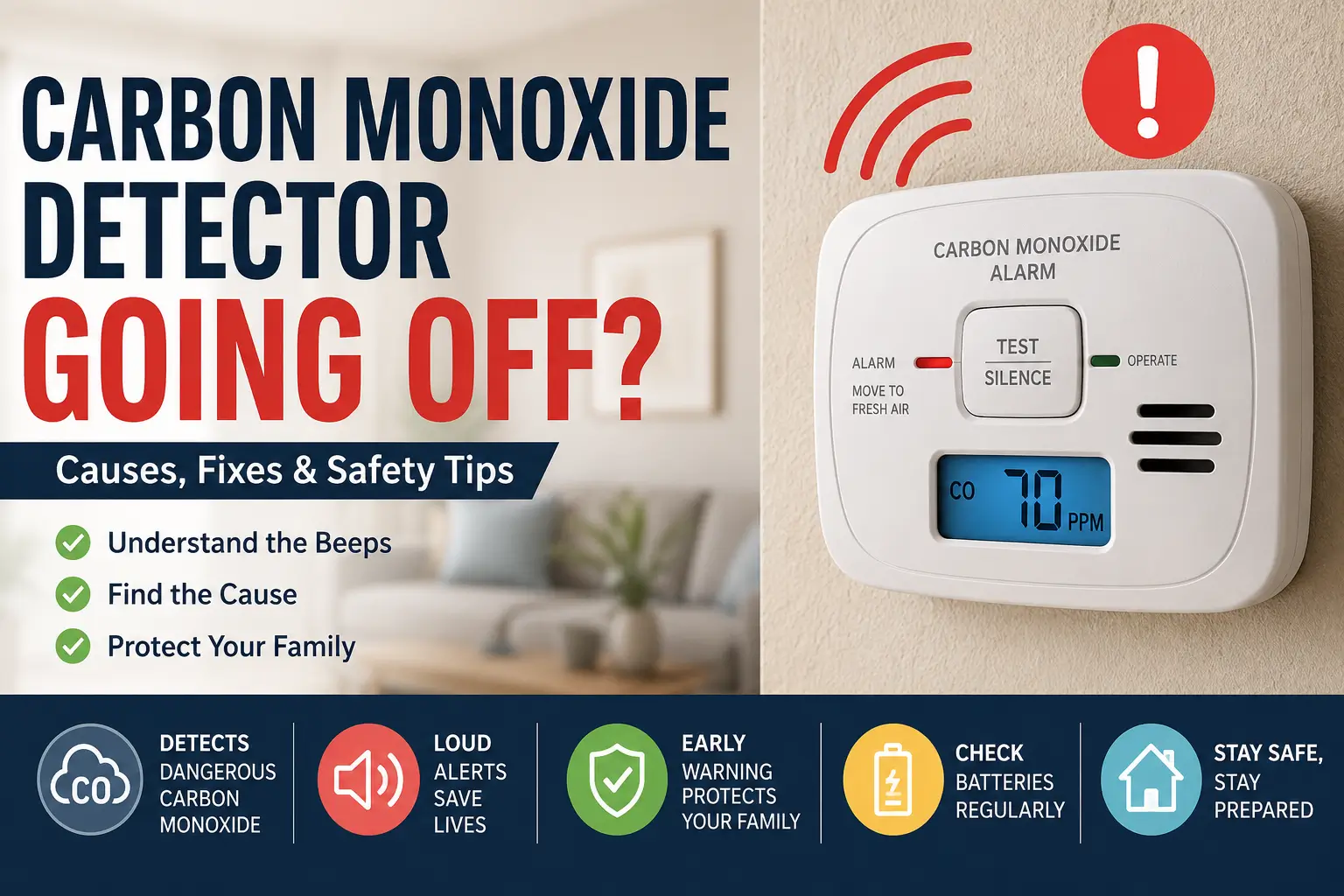
A carbon monoxide detector going off can catch you off guard fast. One second the house is quiet. Next second? Loud beeping in the hallway.
Not fun.
Sometimes it keeps screaming. Sometimes it stops after a few seconds. And honestly, that’s what confuses most people.
Especially if you have a First Alert Carbon Monoxide Alarm and the sounds don’t seem to make sense.
The important thing is this: don’t ignore it. Even short alarms can point to a real carbon monoxide problem.
Table of Contents
Quick Answer: Why Is Your Carbon Monoxide Detector Going Off?
Usually, a carbon monoxide detector goes off for one of these reasons:
- Carbon monoxide in the air
- Low batteries
- Old detector sensor
- Dust inside the unit
- Power interruptions
- Humidity or temperature changes
Sometimes it’s serious.
Sometimes it’s not.
You still need to check.
Quick Information Table
| Problem | Possible Cause |
|---|---|
| Continuous loud alarm | Dangerous CO levels |
| Chirp every 30–60 seconds | Low battery |
| Random short beep | Dust or sensor issue |
| Alarm then stops | Temporary CO spike |
| 2 beeps | Trouble signal or malfunction |
What Carbon Monoxide Actually Does
Carbon monoxide is dangerous because you usually don’t notice it.
No smell. No color. No warning signs.
People often mistake early symptoms for exhaustion or the flu.
Things like:
- Headaches
- Dizziness
- Nausea
- Brain fog
- Weakness
That’s why detectors matter so much.
They catch the problem before you can.
First Alert Carbon Monoxide Alarm Beep Meanings
A First Alert Carbon Monoxide Alarm uses different sounds for different warnings.
Here’s the basic breakdown.
| Beep Pattern | Meaning |
|---|---|
| 4 loud beeps + pause | Carbon monoxide detected |
| 1 chirp every minute | Low battery |
| 5 chirps | Detector reached end of life |
| Random chirps | Sensor or electrical issue |
Some models vary a little. So checking the manual helps.
Still, four loud beeps repeating over and over? Treat that like an emergency.
Immediately.
Carbon Monoxide Detector Going Off Then Stops
This happens more than people think.
A carbon monoxide detector going off then stops usually means the detector sensed carbon monoxide briefly, but the levels dropped before they became consistently dangerous.
A few common reasons:
- Car running in attached garage
- Fireplace smoke drifting indoors
- Gas stove without ventilation
- Furnace kicking on after months unused
Winter mornings are notorious for this.
A lot of homeowners hear one short alarm when the heat starts for the first time in the season.
Dust burns off. Air quality changes quickly. Detector reacts.
Still worth checking though.
Always.
My Carbon Monoxide Detector Went Off for a Few Seconds
If your carbon monoxide detector went off for a few seconds, don’t brush it off too quickly.
Short alarms can happen from temporary air contamination.
Cooking fumes sometimes trigger them. Same with generators nearby. Or poor airflow.
And occasionally? Weak batteries make detectors behave strangely.
Start simple.
Try this:
- Open windows
- Check appliances nearby
- Replace batteries
- Vacuum around detector vents
- Look at the detector age
If the unit is older than 5–7 years, replacement is usually smarter than troubleshooting forever.
Carbon Monoxide Detector Going Off but No Gas Appliances
This part surprises people.
A carbon monoxide detector going off but no gas appliances doesn’t automatically mean the alarm is wrong.
Carbon monoxide can come from outside the home too.
Things like:
- Attached garages
- Running vehicles
- Portable generators
- Wood-burning fireplaces
- Neighbor’s exhaust nearby
Even charcoal grills can create problems if they’re too close to windows or doors.
One small mistake is enough sometimes.
Why Is My Carbon Monoxide Detector Going Off 2 Beeps?
If you’re asking, “Why Is my carbon monoxide detector going off 2 beeps,” the issue is usually maintenance-related.
Not necessarily dangerous carbon monoxide.
Two beeps often point to:
- Sensor trouble
- Battery problems
- Internal fault
- End-of-life warning
Most detectors don’t last forever.
A lot of people forget that part.
Quick Fixes
- Replace the batteries
- Hold the reset button
- Clean dust from vents
- Check manufacturing date
- Replace expired detector
Simple stuff first.
Carbon Monoxide Detector Going Off Every 30 Seconds
A carbon monoxide detector going off every 30 seconds usually means the detector itself needs attention.
Not always a gas leak.
Most of the time it’s:
- Low battery
- Dirty sensor
- Loose wiring
- Expired detector
That constant chirping drives people crazy too.
Especially at night.
How To Stop the Beeping
Check the battery, clean the detector, and reset the alarm to stop the beeping safely.
Replace the Battery
Use brand-new batteries. Not old ones from a drawer.
Reset the Detector
Press and hold the reset button for around 15 seconds.
Clean It
Dust buildup causes more false alarms than people realize.
Replace Old Units
Most carbon monoxide detectors have a lifespan between 5 and 10 years.
After that, reliability drops.
If You Reset a Carbon Monoxide Detector Will It Go Off Again?
Yes. It can.
If you reset a carbon monoxide detector and the underlying issue is still there, the alarm will probably come back.
Resetting only clears the current warning.
It doesn’t magically solve:
- Carbon monoxide leaks
- Failing sensors
- Ventilation problems
- Faulty appliances
That part matters.
A lot.
Common Mistakes People Make
People accidentally cause false alarms all the time.
Usually without realizing it.
Here are some common ones:
- Installing detector near bathroom steam
- Putting it directly above stove
- Ignoring low battery chirps
- Never checking expiration dates
- Blocking airflow around unit
Bad placement creates headaches.
Best Places To Install Carbon Monoxide Detectors
You want detectors:
- Near bedrooms
- On every floor
- Near attached garages
- Close to fuel-burning appliances
Avoid placing them:
- Right beside windows
- Inside humid bathrooms
- Near air vents
- Directly over cooking appliances
Placement matters more than most people think.
Signs of Carbon Monoxide Poisoning
This is the serious part.
If several people in the house suddenly feel sick at the same time, pay attention.
Especially if symptoms improve outdoors.
Watch for:
- Headaches
- Dizziness
- Vomiting
- Confusion
- Weakness
- Chest pain
Get outside first.
Then call emergency services.
Troubleshooting Checklist
A quick troubleshooting checklist helps you identify common issues fast and keep your carbon monoxide detector working properly.
Alarm Sounds Continuously
- Leave immediately
- Open windows if safe
- Call emergency services
Detector Chirps Occasionally
- Replace batteries
- Reset detector
- Clean vents
Alarm Keeps Returning
- Check appliances
- Improve ventilation
- Call HVAC technician
- Replace old detector
Frequently Asked Questions
Can a carbon monoxide detector go off falsely?
Yes. Dust, humidity, low batteries, and electrical issues can trigger false alarms sometimes.
Still smart to take every alarm seriously first.
Why does my detector beep more at night?
Cooler nighttime temperatures can affect weak batteries. Plus the house is quieter, so chirping sounds much louder.
How long do carbon monoxide detectors last?
Most last around 5–10 years depending on the brand and model.
After that, replacement is recommended.
Can opening windows stop a carbon monoxide alarm?
Sometimes temporarily. Fresh air lowers CO levels.
But you still need to find the actual source.
Are smart carbon monoxide detectors worth it?
For many homes, yes.
Smart models send alerts directly to your phone and can warn you while you’re away.
Should I replace my detector after repeated false alarms?
Usually yes, especially if it’s older.
A failing sensor becomes unreliable over time.
Why You Should Never Ignore a Carbon Monoxide Alarm
A carbon monoxide detector going off is never something you want to ignore.
Even if the alarm stops.
Even if it only beeped for a few seconds.
Sometimes the issue is minor. Low battery. Dust. Old sensor.
Sometimes it’s not.
That’s why it’s worth checking every single time. Replacing old detectors, testing alarms monthly, and paying attention to weird beep patterns can make a huge difference when it comes to home safety.
And honestly? Peace of mind alone is worth it.
Citations
Carbon Monoxide: The Invisible Killer: National Safety Council Carbon Monoxide Safety